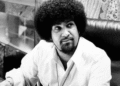

Marvin Gaye & Tammi Terrell were not able to perform in 1970. Tammi Terrell’s health had deteriorated in 1969, leading to further surgery in January 1970, which was unsuccessful. She died on 16th March, at just twenty-four years of age. Marvin Gaye gave the eulogy at her funeral in Philadelphia, with “You’re All I Need to Get By” playing. The loss of his partner had a deep effect on him, which can be seen in his music.
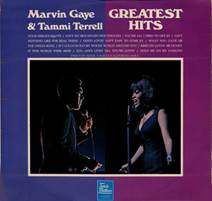
In July, Tamla released a compilation album of their best duets. “Marvin Gaye and Tammi Terrell’s Greatest Hits” is a wonderful collection of love songs, a fitting tribute to a very talented singer.
Marvin Gaye started 1970 in a sombre mood, for a variety of reasons. He had grown disillusioned with the music he was recording at Motown, and was shaken by Tammi Terrell’s worsening condition, but that is not what the record releases show. Instead, work from 1969 that was issued in 1970 suggests that life was continuing as usual.
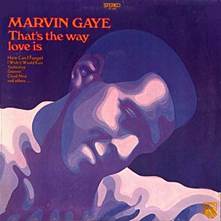
Gaye’s tenth studio album, “That’s The Way Love Is”, appeared on the market on 8th January, having generated the last two singles of 1969, featuring seven songs co-written by producer Norman Whitfield and Barrett Strong (two with Roger Penzabene), two songs co-written by Norman Whitfield and Eddie Holland (one with R. Dean Taylor), and three non-Motown covers, including Dick Holler’s “Abraham, Martin And John”. Amongst the nine Motown songs, three are Temptations covers and two more are covers of Isley Brothers and Jimmy Ruffin songs. It looks like a strong collection, with a nice variety of styles, but the album only reached number one hundred and eighty-nine on the Billboard 200 Albums Chart and number seventeen on the Billboard R&B Albums Chart. Marvin Gaye’s absence from the touring circuit obviously hindered sales.
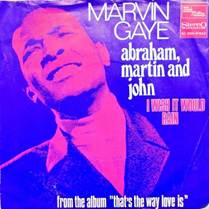
Nevertheless, “Abraham, Martin And John”, which is the opening track on side two, is beautifully sung, against a subtle orchestral backing; it is the best track on the album. It was released in the UK on 9th May and peaked at number nine on the Official UK Pop Singles Chart but wasn’t issued in the USA.
There was a single released in America, but it offered two songs from the past. A reworked version of Gladys Knight & the Pips’ 1968 hit “The End Of Our Road”, drawn from Gaye’s 1968 album “M.P.G.”, was paired with “Me And My Lonely Room”, from Gaye’s 1964 album “How Sweet It Is To Be Loved By You”. Both songs were co-written by Whitfield and Strong and produced by Whitfield. Many fans had the songs already in their collections, so the single did well to reach number forty on the Billboard Hot 100 Singles Chart and number seven on the Billboard R&B Singles Chart.
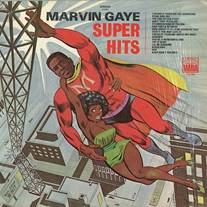
There was also a second album from Marvin Gaye released by Tamla in September, a compilation of all his hits from 1962 to 1969, entitled “Super Hits”. It is an excellent summary of Gaye’s progress as a performer, that peaked at number nineteen on the Billboard R&B Albums Chart but only just made the top one hundred on the Billboard 200 Albums Chart.
For Motown, these releases were filling a gap! Marvin Gaye had secluded himself from the recording studio after Tammi Terrell had died. He was struggling with a cocaine addiction and his marriage to Anna Gordy was in difficulties. He tried to distract himself by training with the Detroit Lions, but he was pre-occupied by thoughts relating to the Vietnam War and the pressures on Black people in America. He later described his state of mind in an interview for Rolling Stone magazine:
“In 1969 or 1970, I began to re-evaluate my whole concept of what I wanted my music to say … I was very much affected by letters my brother was sending me from Vietnam, as well as the social situation here at home. I realized that I had to put my own fantasies behind me if I wanted to write songs that would reach the souls of people. I wanted them to take a look at what was happening in the world.”
One specific incident led him to his next song. Renaldo Benson, one of the Four Tops, was on a tour bus in May 1969, when he saw police attacking anti-war protesters at the People’s Park in Berkeley, California. The incident led to around one hundred and thirty local people being injured by the police and one death; it was named Bloody Thursday and prompted Governor Ronald Reagan to call a state of emergency in Berkeley, sending in the National Guard. Benson discussed the incident with friends and colleagues, one of whom, Al Cleveland, decided to write a song inspired by Benson’s account. The song was offered to the Four Tops, who turned it down. They did not want to sing a protest song, despite Benson’s insistence that it wasn’t a protest song but a love song, seeking understanding.
Benson was frustrated by his failure to convince his fellow Tops, but he played the song to Marvin Gaye, who was keen to run with it. Gaye thought that it would suit the Originals, whom he was producing, but Benson wanted Gaye to record it. Finally Gaye agreed, when Benson allowed him to make some alterations to the lyrics and tweak the melody in places. Benson was highly impressed by Gaye’s changes: “We measured him for the suit and he tailored the hell out of it”.
The result was a song that would take Marvin Gaye and Motown into new territory.
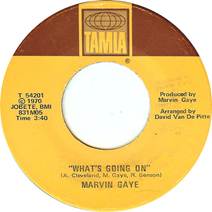
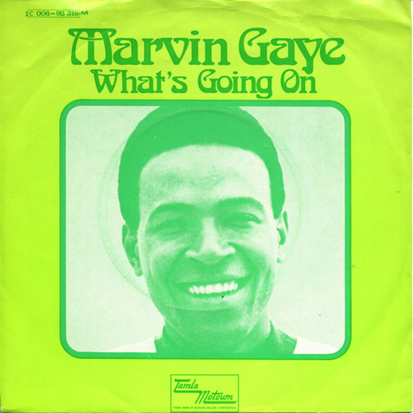
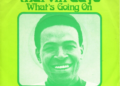
Marvin Gaye went back to Studio A for the first time in months on 1st June, ready to record “What’s Going On”. He had grown a beard and was probably wearing a sweatsuit; he wasn’t the old Marvin Gaye and the music wasn’t going to be the old Detroit Soul. Gaye took charge of production, bringing in some of the Funk Brothers (Jack Ashford, James Jamerson, Eddie “Bongo” Brown) but also inviting some other hand-picked musicians, including drummer Chet Forest and saxophonist Eli Fontaine. It is Fontaine and Jamerson who play the song’s intro over a jumble of voices. David Van DePitte’s arrangements have strong elements of Jazz and Gospel, with classical strings. Two key elements of the song are the multi-tracked backing vocals and the layering of Gaye’s two lead vocal lines, which may well have resulted from an accidental overdub by engineers Steve Smith and Kenneth Sands.
Most of the recording was completed in Studio A, with additional tracks being done in Studio B. The final mix was completed in the Donovan Building. In September, Gaye took the finished recording to California, to let Berry Gordy hear it. Gordy listened and is reported to have described it as “the worst thing I ever heard in my life”. Gordy ‘s memory of his reply is different, however. He loved the Jazzy elements but was concerned that the public wouldn’t respond positively to the lyrics or the musical variations. Whatever was said, Motown’s Quality Control team turned the song down!
Gaye returned to the studio in Detroit and continued working on material for a series of tracks, some of which would be added to “What’s Going On” to make an album. He made it clear to Motown’s management that he would continue down his chosen path.
“What’s Going On” marks a radical change of direction for Marvin Gaye and for Motown. It is one of the most important songs that Motown ever released!