
Smokey Robinson & the Miracles could look back over their achievements in 1969 and feel very satisfied with progress. Their three album releases had all made the top one hundred on the Billboard 200 Albums Chart and two had entered the top seven of the Billboard R&B Albums Chart. Five of their six singles had also sold well. Yet, at the start of that year, Smokey Robinson had begun to think about leaving the group, in order to concentrate on his wider work within the company as Vice-President and his family responsibilities.
At the start of 1970, his thoughts of leaving were almost certainly still present. Then, at the end of April, Tamla issued an album on the 28th and a single on the 29th. The album “What Love Has Joined Together” went to number nine on the Billboard R&B Albums Chart, while the single “Who’s Gonna Take The Blame” also rose to number nine on the Billboard R&B Singles Chart. Two more reasons for him to stay!
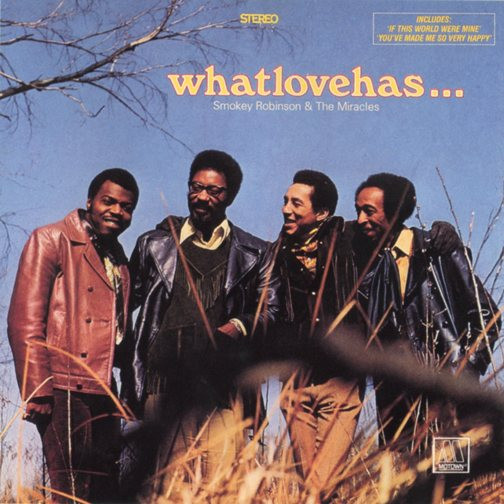
“What Love Has Joined Together” is a very short album with a playing time of only around thirty minutes and only six tracks, all love songs. It is also unusual in featuring no new compositions and only one song written by Smokey Robinson and Bobby Rogers, the title track, which Mary Wells had recorded in 1963 and the Temptations had recorded in 1965. The album also offers three other Motown covers and two well-known non-Motown covers, Bacharach and David’s “This Guy’s In Love With You” and Lennon and McCartney’s “And I Love Her So”.
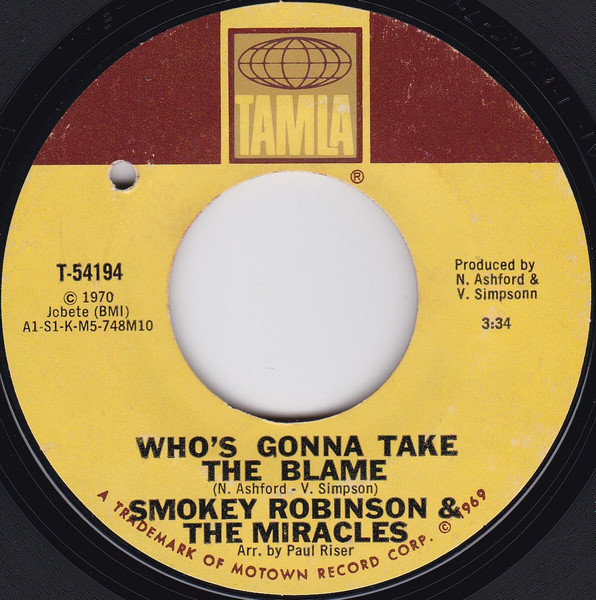
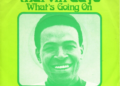
Surprisingly, the single was not drawn from the April album. Instead, the group recorded a beautiful song co-written by Ashford & Simpson with an arrangement by Paul Riser, entitled “Who’s Gonna Take The Blame”. It is a fine example of the “new” Motown songwriting, as it tells the story of a child who grows up to turn to prostitution:
“Now you’re all grown up and you’re running wild
And they’re so surprised ’cause all along, you seemed like such a sweet child
And there’s nothing but bad news from all the friends I meet
How you’ve become a, a woman of the streets, oh
And they give me a million and one reasons why
But when I analyze it, I know where the real fault lies, oh
Who will take the blame? Who’s gonna bear the shame?
No doubt about it, ooh, this time rightfully
Put the blame, put it on me, oh-oh
Who will take the blame? (Who’s, I said, who’s) Who’s gonna bear the shame?
Put the blame, put it on me, oh-oh”
The song would appear on the follow-up album, “A Pocketful Of Miracles”. Also on the album are the last two of the 1969 single releases “Point It Out” and “Darling Dear” and seven other Motown compositions, plus two non-Motown covers: “Something/ Something You Got” and “Bridge Over Troubled Water”. The second stand-out track is “Get Ready”, which Smokey Robinson had written for the Temptations. He does a fine job with his own song. The album was released on 30th September and peaked at number ten on the Billboard R&B Albums Chart and number fifty-six on the Billboard Hot 200 Albums Chart.
Prior to that, however, any thoughts that Smokey Robinson still harboured of stepping away from performing were shattered by a success in the UK.
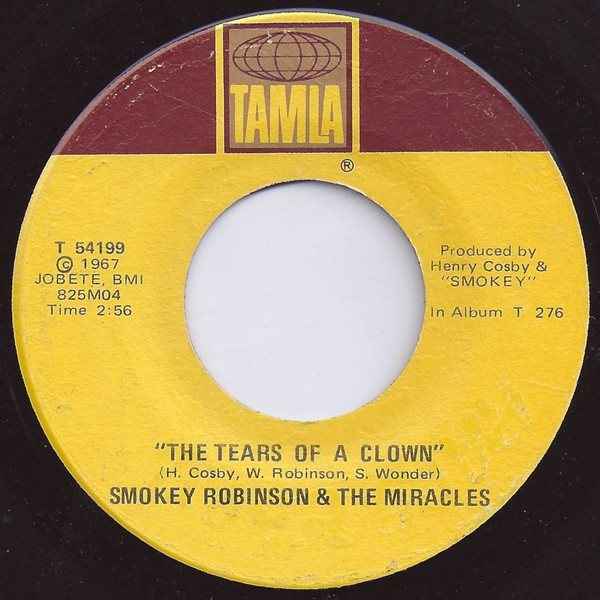
The story goes that Karen Spreadbury, who was running the Motown fan club in Britain, suggested to John Reid that a track from the 1967 album “Make It Happen” should be released as a single. Reid was head of Tamla Motown in the UK and he agreed that issuing “The Tears of a Clown” was a good idea. For the B-side he chose “Who’s Gonna Take The Blame”! The single was released in the UK in July, then in Sweden and Australia. By 12th September it was number one on the Official UK Pop Singles Chart and number seven in Australia.
Motown took notice. Parts of the original recording had already been re-recorded and a new mix was created in February 1970. This version was chosen for release in America, with “Promise Me” on the B-side. The song was also released internationally, with a variety of B-sides in different countries. Within two months, the single was number one on the Billboard Hot 100 Singles Chart, the Billboard R&B Singles Chart and the Cash Box Top 100 Singles Chart, selling over three million copies. It entered the top ten of the charts in Belgium, Canada, Ireland and Holland.
The song has an interesting history. The music for the song was written by Stevie Wonder in 1966. Then, Hank Cosby had produced an instrumental track with the Funk Brothers. Stevie Wonder had taken that recording to Smokey Robinson to see if he could come up with some lyrics. Robinson has explained that the music reminded him of a circus, so he followed that thought back to a line that he had written in a 1964 song, “My Smile Is Just A Frown (Turned Upside Down)”, which Carolyn Crawford had recorded. The line was: “just like Pagliacci did/ I’ll try to keep my sadness hid”. It was perfect, so he used it again!
“Just like Pagliacci did, I try to keep my sadness hid,
Smiling in the public eye.
But, in my lonely room, I cry the tears of a clown,
When there’s no one around.”
It is difficult to know for sure who played on the two versions, but the session musicians certainly included Charles R. Sirard on bassoon, who added an element of originality typical of Motown. The opening is unmistakeable. The song went on to sell millions of copies world-wide. It was a hit again in 1976 in the UK and was inducted into the Grammy Hall of Fame in 2002.
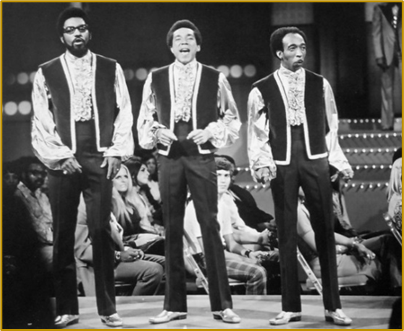
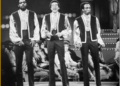
Smokey Robinson & the Miracles TV Special 1970
(minus Pete Moore who had injured his leg)
Photo: ABC Television Promotional Image (Wikimedia Commons)
The group’s success was reflected in the decision by ABC Television to broadcast a special, which they called The Smokey Robinson Show, featuring Smokey with the Miracles, plus guest stars the Supremes, the Temptations and Stevie Wonder. After all that, Smokey Robinson decided to stay with the Miracles for another year. Sadly, the year ended with the release of a Christmas album, “The Season For Miracles”, which failed to chart!