
Ollie T. Hunt was born in 1917 in Los Angeles. He was a Black entrepreneur with an unusual approach to making his way in the music industry. During the 1940s he travelled around the Bay Area making private recordings for families or recordings for singers who wanted a demo disc. He met Bob Geddins during his travels and may well have asked him to press discs from his recordings. Like Geddins, Hunt must have had some practical engineering skills; he probably put together a portable recording unit that he could take to his clients.
Between 1946 and 1949, Hunt set up his first labels, Olliet Records (Ollie T), Oliver Records, and Gru V Tone Records, probably all based at 2405 San Pablo Avenue, Oakland. He also produced records for a number of private companies, creating new labels for them, such as Golden Gate Records (1947) and Fentone Records (1949). In addition, he added a Gospel label to his stable, which he called State Negro Spirituals.
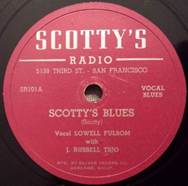
Hunt also set up a store called Scotty’s Radio at 5139 Third Street in San Francisco, for which he created a promotional label which issued just one disc.
The final label that he established was Trilyte in 1955. It ran for about a year. After that, Hunt decided to work as a recording engineer for the Bihari brothers.
All of Hunt’s labels were small. Trilyte issued around five or six 7” 45rpm vinyl singles between 1955 and 1956. All the earlier labels issued 10” 78rpm shellac discs. Oliver released a handful during the late forties, Gru V Tone added another half dozen, Olliet issued seven or so, with the private labels accounting for another dozen perhaps. The Gospel label issued more, but there is little information about them.
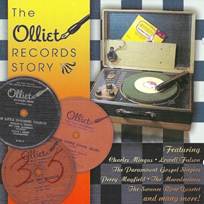
Thanks to the work of Opel Louis Nations, the UK’s Acrobat Records was able to issue a two-CD compilation of tracks from Ollie T. Hunt’s various labels in 2008. The collection is comprised of fifty-five tracks, covering a wide range of musical genres. Twenty-four are Gospel songs, and two are Jazz. The other twenty-nine are Blues, Boogie-Woogie or R&B.
Selected artists on the Ollie T. Hunt labels.
Olliet
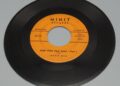
Tommy Jenkins’ “Freedom Choo Choo” is a pure piano Blues. Jenkins also recorded two Gospel tracks for Bob Geddins’ Big Town label, with Mildred Falls playing the piano backing. The track is one of the first recorded by Hunt, dating from 1946. Naomi Mack is the pianist this time. The track is the A-side of a single that has the following Naomi Mack track on the reverse.
Naomi Mack probably only ever recorded one solo track. Her contribution to the Acrobat compilation is “Tight Key Boogie”, a spirited piano instrumental from 1946.
James Nelson was born in 1919 in Philadelphia, but his musical career began when he saw Big Joe Turner at a concert in Oakland, California, in 1941. Turner became his mentor, and Nelson modelled his singing style on Big Joe. His first recordings were made in Oakland for Ollie T. Hunt’s Olliet label in 1948.
Nelson went on to enjoy a fifty-year career as a singer and songwriter, recording with RPM from 1951 to 1953, and then with Music City. One of his RPM songs, “T-99 Blues”, went to number one on the Billboard R&B Singles Chart in 1951.
The UK’s Ace Records issued three compilations of Nelson’s songs in 1981, 1987, and 2003.
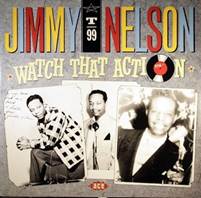
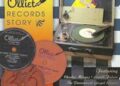
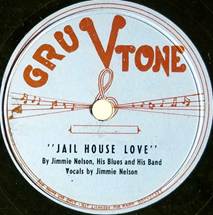
Jimmy Nelson has three tracks included on the “Olliet Records Story” compilation. They are “The Cats Creep At Midnight”, “Baby Chile”, (the tracks from Nelson’s 1949 Olliet single) and “Jail House Love” (on the Gru-V-Tone label). Strangely, the first is an instrumental, but the other two are slow Blues with a very Jazzy backing. Both are orchestral Blues, which, like Mayfield’s opening single from 1947 below, demonstrate how Blues and Jazz were merging into R&B.
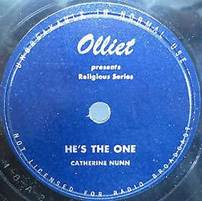
The remaining issues on the Olliet label were Gospel singles by the Spartonaires, Sister Jeannie Ross, the Swanee River Quartet, and Catherine Nunn (above).
Gru V Tone
Percy Mayfield was born in Minden, Louisiana, in 1920. He was attracted to poetry as a youngster and later took up singing and songwriting, mainly around Houston in Texas. He came to Los Angeles in 1942, hoping to make money by performing and by persuading other artists to record his songs.
Five years later, his first chance to make these things happen came at Gru-V-Tone, for whom he recorded two singles, probably in 1947. The first was “Jack, You Ain’t Nowhere” (1947) and the second was “Two Years of Torture” (1948). The serial numbers (101 and 102) suggest that these were the label’s first two issues.
The first, “Jack, You Ain’t Nowhere”, is a mid-tempo song in the style of Louis Jordan. The tinkling piano backing and the call and response with the backing singers is typical of the most popular Race Records of the post-war era. The B-side is an instrumental version of the song. It is not particularly original.

The follow-up, “Two Years Of Torture”, is a Blues ballad, with a piano and saxophone leading the backing band. It showed just how good Mayfield could be. Other people noticed too, eventually! Mayfield went to Supreme in 1949, hoping that he could persuade Jimmy Witherspoon to record “Two Years Of Torture”. Instead, Supreme asked Mayfield to record the song. It wasn’t a hit, but it opened some doors for Mayfield. In 1950, he recorded some tracks at Specialty and in 1951 he cut a single at Swing Time. There was a lot more success ahead.
The two versions of “Two Years Of Torture” can be heard on Jasmine Records’ 2016 Percy Mayfield compilation “Lost Love: The Singles As & Bs 1947-1962”.
Jimmie Nelson’s “Jail House Love”/ “Baby Chile” was released in 1949.
Pianist David Lee Johnson recorded two Blues tracks for Gru-V-Tone in 1947, “Hemlock Blues” and “Who Can You Blame”. The first is an instrumental, which has a slow Boogie-Woogie feel to the piano, with a rather unusual electric guitar solo that seems not to match the style of the song. The second is a slow, vocal Blues, again backed by piano and guitar.
The final group whose Gru-V-Tone single survived is the Crayton Trio, whose members were Joe Lee Alcarn (bass), David Lee Johnson (piano), and Pee Wee Crayton (guitar and vocal).
Pee Wee Crayton was born in Rockdale, Texas, in 1914. He came to California in 1935 and was inspired by T-Bone Walker to learn to play the electric guitar. His first foray into a recording studio came in 1945, when he cut the first two singles issued by Laurent Records in San Francisco, as a member of the King’s Quintet.
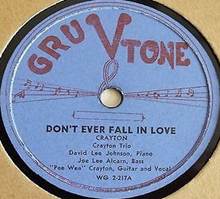
The date of his trio’s Gru V Tone single isn’t known, and the serial number WG 2-217 doesn’t help much. Crayton signed a contract with Modern Records in 1948, so the Gru V Tone single is probably from 1947 or early 1948. “Don’t Ever Fall In Love” is a slow Blues, with piano and guitar backing. The single-note style is very distinctive. The B-side is an up-tempo Jump Blues dance track.
Crayton went on to build a solid career at Imperial, recording in New Orleans, and at Vee-Jay in Chicago. He developed his own style of guitar playing and may have been the first Blues guitarist to play a Fender Stratocaster. He was given one by Leo Fender himself.
Oliver Record Co.
Oliver Record company first appears as a production company that manufactured a number of singles for other companies.
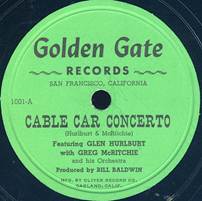
This Golden Gate disc was manufactured for a San Francisco enterprise in 1947.
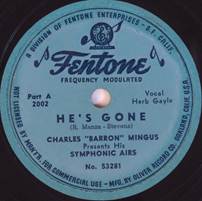
Fentone Enterprises was also a San Francisco operation for which a Jazz single was produced in 1949 by Oliver Record Co. It was probably the first ever recording by Charlie Mingus. Interestingly, the label is marked as “not licensed by manufacturer for commercial use”.
Oliver Record Co. also produced three singles for the Duncan sisters, before an Oliver label finally appeared in the fifties. It was a Greek dance music track and was followed by other folk music for Italian and Hawaiian dances. A very niche market in Oakland, one would think.
Scotty’s Radio
Lowell Fulson recorded the two promotional tracks for the Scotty’s Radio single, probably at Bob Geddins’ studio in 1947. “The Train Is Leaving” and “Scotty’s Blues” are both gentle, slow Blues. Lowell’s vocal is backed by his soft guitar and a more complex piano line.
Trilyte
Trilyte was Ollie T. Hunt’s final label.
Lafayette Thomas was born in Shreveport, Louisiana, in 1928. He was a Blues singer and guitarist, whose career began when he joined Al Simmons’ Rhythm Rockers in 1947. The following year he played with Bob Geddins’ Cavaliers. He features as guitarist on a number of Cava-Tone recordings from 1948, including several by Jimmy Wilson. He later joined Jimmy McCracklin’s Blues Blasters in 1951 (replacing Robert Kelton) and Jimmy Wilson’s All Stars, with whom he recorded at Aladdin during the early fifties. Subsequently, he worked with James Reed, Roy Hawkins, Memphis Slim, and Sugar Pie DeSanto. He died at the age of forty-eight in 1977.
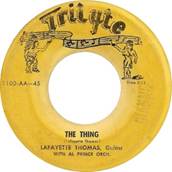
“The Thing” (1955) is a powerful up-tempo instrumental. Thomas leads the way on electric guitar, backed by the Al Prince Orchestra. The B-side is a slow Blues entitled “Weekly Blues”. Both are Lafayette Thomas compositions. The quality of the recordings is good, and Thomas’ high-energy, dynamic playing style stands out.
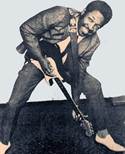
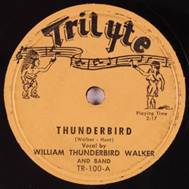
William “Thunderbird” Walker recorded two R&B Pop songs, “Thunderbird” and “I’m Thinking Of You” for the Trilyte label in 1956. Both songs are credited as written by Walker and Ollie T. Hunt.
The Shantones made one Doo-Wop single at Trilyte, “Come To Me”/ “Little Girl”, which was also issued in 1956.
The Trilyters have just two tracks listed. Both are up-tempo R&B dance tracks, “The Beat” and “Two-O-Five Jump”, an instrumental.
King Perry brought a touch of R&B to the label with his orchestral dance tracks “Come Back Baby” and “It Takes A Man Like Me”.
The Acrobat compilation also includes a couple of songs that were issued during the early fifties on the Octive label. It is possible that they were recorded by Ollie T. Hunt for Octive, possibly in Oakland or Los Angeles. The label was part-owned by bandleader King Perry, who recorded for Trilyte in 1956, and Hunt may have had a share of the company too. However, the Octive label from the sixties shows an address in San Diego.
Octive
John Hogg sings in a Country Blues style, with a simple guitar accompaniment. “Worrin’ Blues” and “Black Snake Blues” were both recorded in 1951.
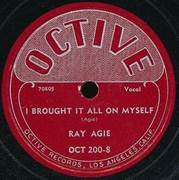
Ray Agee’s “I Brought It All On Myself” (1952) is another piano/guitar slow Blues, but this one has a Jazzy saxophone solo.
The Shantones tracks were probably the final recordings on Trilyte. Ollie T. Hunt had a ten-year spell as a label owner and producer. For a Black entrepreneur, that was an exceptional run, given the difficulties facing him and his colleagues, such as Bob Geddins.
The list of artists that he worked with includes some well-known names and some that are hardly known at all, but all the recordings made for his own and other people’s labels have real points of interest. He attracted some talented performers to his Oakland studio and helped several important musicians to take their first steps in the music business. He died in 2001 in Los Angeles.