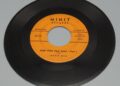

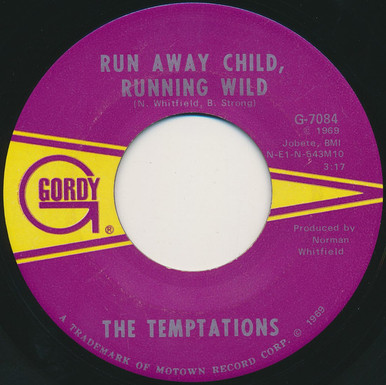
The Temptations returned to the top of the Billboard R&B Singles Chart with “Run Away Child, Running Wild”, week-ending 22nd March 1969 (2 weeks), and also matched the success of 1968’s “Cloud Nine” single by climbing to number six on the Billboard Hot 100 Singles Chart. The single was released on 30th January 1969, and later achieved gold certification from the RIAA. Like the 1968 “Cloud Nine” single, it was a complete departure from the Temptations’ earlier recordings. “Run Away Child, Running Wild” incorporates electric guitar with wah-wah pedals used to create distortion effects and a heavy bottom base line from the Funk Brothers Dennis Coffey and Bob Babbitt, supported by the driving force of hi-hat beats from Uriel Jones on drums. It was indeed a radical follow up to “Cloud Nine”, clocking over 9:38 minutes in length, setting a trend followed by Isaac Hayes on his June 1969 solo album “Hot Buttered Soul”, which also features several long tracks.
All five members of The Temptations shared lead vocals during the recording of the track. This was a new approach to vocal arrangements for the group, which set the Temptations apart from many other vocal groups, who were still following the pattern of one lead vocalist supported by other group members singing backing vocals. It was group member Otis Williams who suggested this new style (based on Sly & the Family Stone recordings) to producer Norman Whitfield. The latter wasn’t keen, at first, but it soon became typical of his interesting and innovative creative ideas, which incorporated progressive styles of music production with various musical elements consisting of soul, R&B and Rock fusions. Under Whitfield’s guidance, the Temptations were able to create a psychedelic sonic landscape filled with expressions of rich musical drama. “Run Away Child, Running Wild” illustrates this well, as the song builds an image of a child or teenager trying to cope with life on the streets of a busy, fast-moving city and hints at the dangers that they face on their own, away from the protection of parents. The track pulses with an unstoppable drive, demanding the listener’s full attention to the narrative. Another Whitfield innovation comes around half way into the album version of the track with the insertion of an extended instrumental section, a device that Whitfield was to use again on later Temptations songs. It was Funk Brothers band leader Earl Van Dyke who played the organ solo, which inspired the idea for an instrumental version of the complete song by him and the Funk Brothers released later in the year.
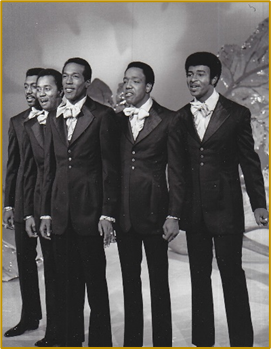
The Temptations 1969
Photo: Bernie Ilson, Inc. (Wikimedia Commons)
The parent album, “Cloud Nine”, was issued by Gordy on 17th February. The two gold singles and a cover of the Gladys Knight & the Pips’ version of “I Heard It Through the Grapevine” make up side one. All three songs are Barrett/ Whitfield compositions. The B-side is less experimental, with seven songs, on which lead vocals are shared by new member Dennis Edwards, Eddie Kendricks, Paul Williams, and Melvin Franklin. The first two songs are covers of non-Motown 1960s hits and five are compositions by Barrett Strong and Norman Whitfield, who were now the pre-eminent creative force at Motown, with support from Eddie Holland, Cornelius Grant and Eddie Kendricks on “I Gotta Find a Way (To get You Back)”.
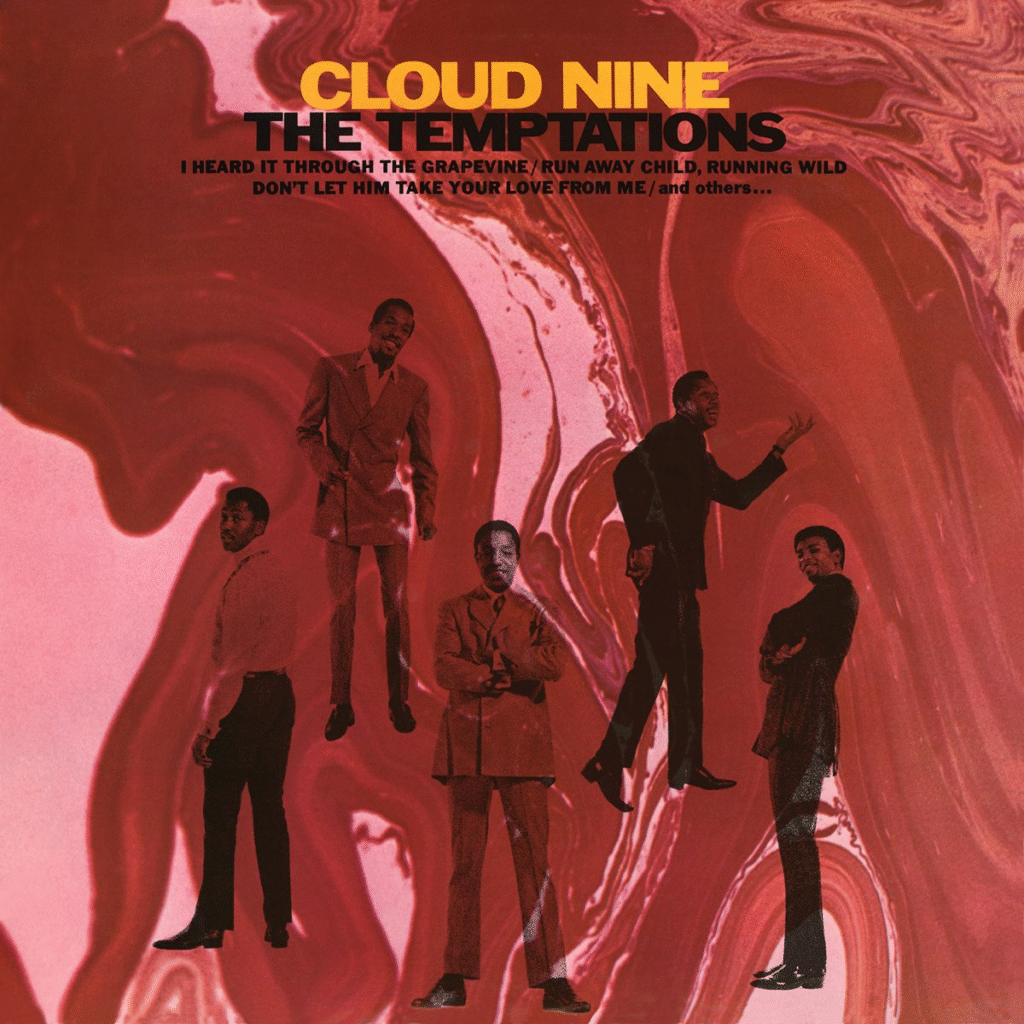
Sales were good, taking the album to number four on the Billboard 200 Albums Chart, week-ending 3rd May 1969. Altogether, it spent over forty weeks on the chart! In the UK, fans may have been less sure about the new style, as the album only reached number thirty-two on the Official UK Pop Albums Chart.
In July, Gordy released a live album called “The Temptations Show” that featured both the recent gold singles plus several of their hits from the mid to late 1960s, produced by Jackie Barnett. It was the soundtrack of a one-hour television special that was broadcast on 10th July, with a couple of guest stars. The album peaked at number six on the Billboard R&B Albums Chart and number twenty-eight on the Billboard 200 Albums Chart.
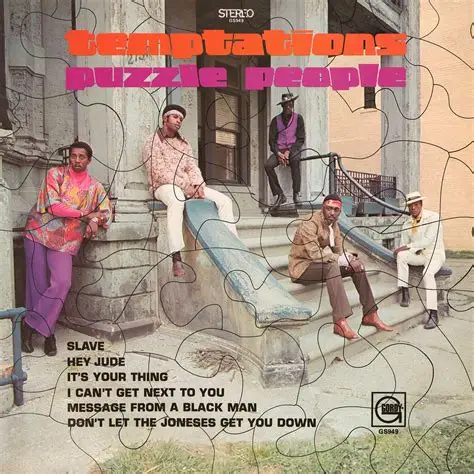
During the same year, in September, another innovative and interesting Temptations album was released by Gordy, entitled “Puzzle People”. As before, Barrett Strong and Norman Whitfield provided most of the songs, co-writing seven of the tracks, one with Roger Penzabene. Whitfield also wrote one without his usual partner Strong. The remaining three songs are covers, first of the Isley Brothers’ “It’s Your Thing”, then of the Beatles’ “Hey Jude” and finally of “Little Green Apples”.
Like “Cloud Nine”, it is a mix of Sly & the Family Stone-inspired psychedelic Funk and more traditional Motown Soul. Two of the covers seem a little out-of-place. Nevertheless, fans in the USA were happy to add the album to their collections, taking it to number five on the Billboard 200 Albums Chart, later earning the group another gold certification. More impressively, it spent fifteen weeks at number one on the Billboard R&B Albums Chart. In the UK too fans seemed to be coming round to the new style, sending the album to number twenty on the Official UK Pop Albums Chart.
Two singles were drawn from the album, the first “Don’t Let the Joneses Get You Down” and then “I Can’t Get Next To You”. The subject of the first is unusual, the peer pressure of trying to keep up with the neighbours. The studio band included Johnny Griffith on piano, (leading the intro), Earl Van Dyke on organ, Dennis Coffey (guitar), 7 in a chicken scratch style, and Uriel Jones applying a lot of hi-hat techniques on the drums. Robert White may have added a second guitar. As on the recent releases, the Temptations all take parts of the lead vocal, with a complex interplay of harmonies. The overall effect is extremely dynamic. Sales were probably below expectation, however, with the single only reaching number twenty on the Billboard Hot 100 Singles Chart and number two on the Billboard R&B Singles Chart, week-ending 21st June 1969, remaining on that particular chart for ten weeks.
The second of the two singles was “I Can’t Get Next To You”, which is more approachable and dance-orientated. It was released by Gordy on 30th July and charted at number one on the Billboard R&B Singles Chart week-ending 4th October 1969 (5 weeks) and on the Billboard Hot 100 Singles Chart week-ending 18th October 1969 (2 weeks). It also reached number one on the Cash Box R&B Singles Chart week-ending 20th September 1969 (7 weeks) and number thirteen on the Official UK Pop Singles Chart. Billboard rated it as the third best song of 1969, and the RIAA later awarded it platinum status.
The single became the second number one for the group on the Billboard Hot 100 Singles Chart, following “My Girl” in 1965. The track starts with some applause before Dennis Edwards comes in and says, “Hold It. Listen”. Immediately you hear a beautiful intro, a New Orleans-style barrel-house piano roll, probably played by Johnny Griffith, before an explosive brass section takes over, followed by Dennis Edwards singing in an aggressive manner, with other members of the Temptations each taking lead vocal throughout the track. The combination of the syncopated percussion and the driving harmonies adds a new dimension to funky Soul. The Temptations’ vocals are more aggressive, more high-energy than anything they recorded prior to “Cloud Nine”, probably thanks to Barrett Strong and Norman Whitfield pushing for more impact.
There are two further noteworthy tracks on the album. “Message From A Black Man” and “Slave” are clearly songs that resonated following recent outbreaks of social unrest in Detroit and many other American cities following the death of Dr. Martin Luther King. They are songs to make the listener think. “Message From A Black Man” echoes some of the Black empowerment songs recorded by the Impressions in Chicago: the message is clearly stated – the colour of my skin does not give the white ruling class the right to hold me back. I am determined to succeed regardless. I will continue with the fight. Indeed, this very intense period in American history will never be forgotten when we can play the brilliant music from that era. The track begins with a lead guitar riff solo before the drummer plays hi-hat soft beats, with additional percussion. There are no horns or strings, just the organ played throughout the entire track by Earl Van Dyke, supported by the bass guitar mixed deep in the recording. The song is very slow compared to the other songs on the album. The tempo and the stripped-back instrumentation makes the track very special. Motown had come a long way in a very short time!
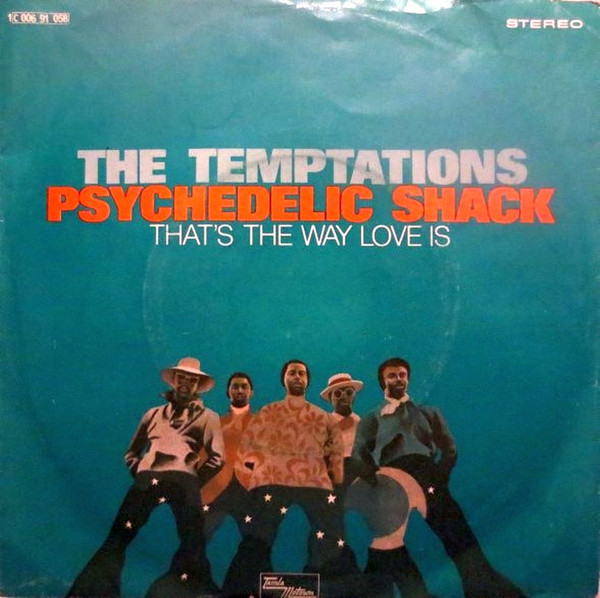
Remarkably, there was still time for one more release. Norman Whitfield brought the Temptations back into the studio at the end of November to record some tracks for a new album, scheduled for release in 1970. On 2nd December the group completed work on “Psychedelic Shack”, which delivered another dose of wailing guitar and driving percussion. The group’s harmonies were as exciting as ever. It was decided to put the track out as a single straight after Christmas. Whitfield and Strong were clearly pursuing the psychedelic Soul sound in their songwriting, but for the B-side they turned to a more conventional Motown sound, using a track from “Puzzle People”, a cover of the Isley Brothers’ song “That’s the Way Love Is”, which Norman Whitfield had co-written with Barrett Strong and produced for the Isley Brothers in 1967 and which Martin Gaye had taken to number two on the Billboard R&B Singles Chart in October 1969, when the Temptations were at number one with “I Can’t Get Next To You”.
So, the Temptations ended 1969 having had two number ones on the Billboard R&B Albums Chart, both produced by Norman Whitfield, starting with “Cloud Nine” week-ending 29th March 1969 (13 weeks) and then followed by “Puzzle People” week-ending 1st November 1969 (15 weeks). The group ended the year at the top of the chart. It was a remarkable performance by the five members, plus Norman Whitfield and Barrett Strong, with a little help from the Funk Brothers and the Detroit Symphony Orchestra, of course!
According to Adam White and Fred Bronson, co-authors of The Billboard Book of Number One Rhythm & Blues Hits (1993): “The group was named the Top Soul Album Artists of the 1960s with thirteen Number One albums, and also Top Soul Singles Artists of the 1960s with nine Number One 45s. They had captured the imagination of a decade.”