
Black & White Records was founded by Les Schreiber in New York in 1943. It was sold to Paul Reiner and his wife Lillian in 1945, who quickly relocated the company to Los Angeles. Ralph Bass was employed as recording director, with Samuel Madiman as treasurer and Larry Newton as sales manager.
In 1947, Reiner struck a distribution deal with Jewel Records, merging the two companies’ catalogues. Reiner then moved the company headquarters to Chicago, leaving Jewel’s president Ben Pollack in charge of the West Coast operation in Los Angeles. During the following year, Ralph Bass left to set up his own label Bop Records. The final releases on the Black & White label came in 1949.
During the four years of its operation in Los Angeles, the company concentrated on Jazz and Blues. The company’s name had been chosen to indicate that both White and Black artists were on the roster, but the most significant contributions came from Black performers T-Bone Walker and Jack McVea. One of their first collaborations at Black & White was “Bobby Sox Blues” from 1946, a slow Jazz-Blues song written by Dootsie Williams, with an even better up-tempo dance track on the B-side, “I’m Gonna Find My Baby”, co-written by Walker with John Criner. It is part Blues, part Jazz, and one 100% R&B. The single climbed to number three on the Race Records Chart.
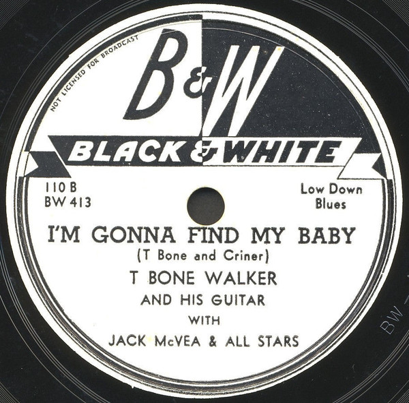
McVea was leader of Black & White’s studio band. He and his band were also successful with a novelty song, “Open the Door, Richard”, which gave Black & White a cross-over hit in 1947.
Aaron Thibeaux (T-Bone) Walker was born in Linden, Texas, in 1910. Both his parents were musicians, but his most important musical influence came from Marco Washington, his step-father, who taught Thibeaux to play piano, ukulele, mandolin, violin, banjo, and, of course, guitar. At the age of ten, he left school and began playing seriously in and around Dallas, under the watchful eye of a family friend Blind Lemon Jefferson.
Walker made his first recording in 1929 for Columbia Records, “Wichita Falls Blues”, credited as Oak Cliff T-Bone, (Oak Cliff was where he was living), and started to build a career as a performer. By 1935, he was married and living on the West Coast, often working as a member of the Les Hite Orchestra, with whom he cut a single for Varsity Records entitled “T-Bone Blues” in 1940.
Two years later, Walker was playing guitar in pianist Freddie Slack’s Orchestra. The newly-formed Capitol Records recorded a number of tracks with the orchestra, including two with Walker singing the lead vocal, “Mean Old World” and “I Got A Break, Baby”. Bill Dahl has noted the significance of these sessions: “This was the first sign of the T-Bone Walker that blues guitar aficionados know and love, his fluid, elegant riffs, and mellow burnished vocals setting a standard that all future blues guitarists would measure themselves by.”
Walker was thirty-two years old in 1942, an experienced performer with a dynamic live act that led to an invitation from Charlie Glenn to go to Chicago to perform a series of shows at the Rhumboogie Café, which Glenn owned. Walker had started playing an electric guitar in the thirties and around 1940 was one of the first performers (maybe the first) to use it as a solo instrument. He also introduced some tricks into his shows, perfecting the art of playing the guitar with his teeth or behind his head, which must have inspired Jimi Hendrix many years later. The shows in Chicago were a great success, leading to three singles being recorded on the Rhumboogie label during 1945 and 1946.
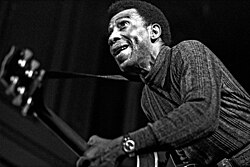
Walker at the American Folk Blues Festival in Hamburg, March 1972
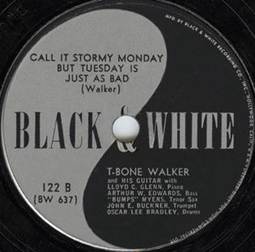
Walker was also making an impact on the West Coast, appearing at the second and third Cavalcade of Jazz concerts at Wrigley Field in Los Angeles in 1946 and 1947. He signed for Black & White Records in 1946, who released nine singles by Walker up to 1948, before he switched to Capitol Records. The stand-out track that he cut at Black & White in 1947 was “Call It Stormy Monday But Tuesday Is Just As Bad”, which became one of his hits on the Race Records Chart. It has become a classic for Jazz and Blues artists, still played today in clubs across the world. Around two hundred covers of the song have been recorded, the most important of which are those by Bobby Bland (1962), Lou Rawls (1962 with Les McCann Ltd and 1966 solo live), Big Joe Turner (1966), Marlena Shaw (1969), and James Brown (1974).
The song was recorded in Hollywood with Ralph Bass producing. The session band was small, reflecting the post-war move away from orchestras and big bands, and included Lloyd Glenn on piano, Arthur Edwards on bass, Oscar Lee Bradley on drums, John “Teddy” Bruckner on trumpet, and Hubert “ Bumps” Myers on tenor saxophone. It was a club combo, perfect for the new style of West Coast R&B Blues.
Walker’s distinctive guitar runs featured a frequent use of ninth chords, which became Walker’s trademark sound and helped take the song to number five on the Billboard Most Played Juke Box Race Records Chart in January 1948. This single along with 1947’s “Bobby Sox Blues” put T-Bone Walker and Black & White Records on the music industry map. In 1983 the song was inducted into the Blues Foundation Hall of Fame. In 1991 the Grammy Hall of Fame honoured the song as “a recording of lasting qualitative or historical significance”. Finally, in 2007, sixty years after it was first recorded, it was added to the Library of Congress’ National Recording Registry. It is indeed a song of great historic and cultural significance.
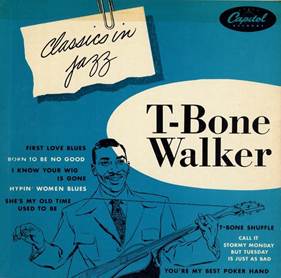
The masters of sixteen of the tracks that T-Bone Walker recorded at Black & White were bought by Capitol in 1949, when Black & White ceased trading. Six had been issued by B&W, while the remaining ten were previously unreleased. Eight singles, featuring all sixteen tracks were released by Capitol during the following few years. A compilation of eight of the best songs appeared in 1954, entitled “Classics in Jazz”.
After the stint at Capitol, he switched again, joining Imperial in 1950 and staying for four years, working with Dave Bartholomew. His career was winding down during the mid-fifties, but there were several later albums issued by Atlantic, Delmark and Polydor. Following a stroke, Walker died in Los Angeles in 1975 at the age of sixty-four.
His importance to the development of Blues and R&B music is obvious from the many musicians who have cited him as a major influence on them. It is a startling list that includes Louis Jordan, B.B. King, Chuck Berry, Lonnie Mack, Jimi Hendrix, and Steve Miller.
Walker was inducted into the Blues Hall of Fame in 1980 and the Rock & Roll Hall of Fame in 1987.