
Etta James was the best-known Chess Records artist who came to FAME to record an album during 1967, in search of a boost for her career which had gone into decline. Between 1960 and 1965, she had recorded five studio albums at Chess Records in Chicago, all released on the Argo label. In 1966 the sixth, “Call My Name”, appeared on Cadet, produced by Leonard Chess. None of them had charted except the first, “At Last”.
Rick Hall had good contacts with the Chicago music companies and must have been confident that Etta James would enjoy working at FAME. Leonard Chess agreed and encouraged James to embrace the opportunity.
In Chicago James had worked with the Chess brothers, covering a range of genres, ranging from Jazz through classic ballads to Blues, Rock and Soul. Chess had tried to market her as the Chicago Queen of Soul, but she was much more than that.
At FAME, the songs she chose reflect her amazing ability to do justice to all kinds of material, and in the FAME session band, she found a group of musicians who had a similar range of abilities. On keyboards were Spooner Oldham and George Davis, with Barry Beckett and Carl Banks on organ, Marvell Thomas on piano, David Hood on bass guitar, Roger Hawkins on drums, and Junior Lowe and Jimmy Ray Jenkins on guitar. The horn section featured Gene “Bowlegs” Miller on trumpet, James Mitchell and Aaron Varnell on saxophone, and Floyd Newman on baritone sax. Charles Chalmers sang background vocals. Rick Hall took care of production.
By the end of the sessions, James had recorded twenty-two songs. Twelve tracks were chosen for inclusion on the album that resulted from the visit.
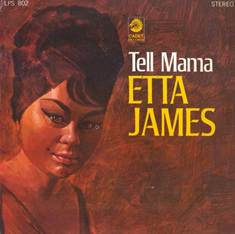
Track One is the title song, “Tell Mama”, written by Clarence Carter, Marcus Daniel and Wilbur Terrell. Track Two is a song originally credited to Billy Foster, a friend of James, but she later explained the song’s origin in different terms in her autobiography Rage To Survive. The song was co-written by James herself, following a prison visit to see another friend Ellington Jordan. He outlined the song to her, and she helped him to finish it. That finished song has become a Blues standard: “I’d Rather Go Blind”.
Also included on the album are songs by Jimmy Hughes, Charles Chalmers, Rick Hall and Spooner Oldham, giving the album a strong Muscle Shoals foundation. There is also a flavour of Memphis, with songs from Otis Redding and Rosco Gordon, and two songs from Don Covay, who had written songs at Stax with Steve Cropper, Booker T. Jones and David Porter.
The album took Etta James back into the charts in 1968, reaching number twenty-one on the Billboard R&B Albums Chart and number eighty-two on the Billboard Hot 100 Singles Chart.
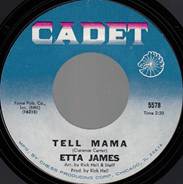
Two singles were released from the album, both of which sold well. “Tell Mama” went to number ten on the Billboard R&B Singles Chart and number twenty-three on the Billboard Hot 100 Singles Chart.
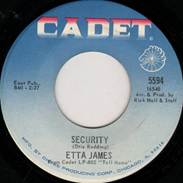
“Security”, a cover of the Otis Redding song, went to number eleven (R&B) and number thirty-five (Pop). In addition, “I’d Rather Go Blind” has become an absolute classic, with the recent version by Joe Bonamassa and Beth Hart outstanding.
The album was re-issued in the 1990s, having been remastered in California at Universal Mastering Studios-West by Erick Labson.
A further release came in 2001, this time a compilation of all twenty-two of the songs recorded at Muscle Shoals. Amongst the added tracks are covers of David Houston’s “Almost Persuaded”, Sonny & Cher’s “I Got You Babe” and Aretha Franklin’s “Do Right Woman, Do Right Man”, which Chips Moman and Dan Penn had written. This version of the album is called “Tell Mama: The Complete Muscle Shoals Sessions”. Confusingly, its cover has the same rather wooden cover image as the original album, with the sole addition of a small sub-title: The Complete Muscle Shoals Sessions.
It seems likely that Etta James and Leonard Chess were acutely aware of the impact that FAME Studios had had on Aretha Franklin and on Wilson Pickett too. It was hard to argue with the successful output of those artists and, given James’ wide-ranging talent, it was no surprise when “Tell Mama” turned out so well for her too.
Sadly, Etta James didn’t record at Muscle Shoals again. She did however make a wonderful album of soulful ballads entitled “Life’s Been Rough On Me”, released in 1997, with Barry Beckett on keyboards and in charge of production. It is well worth a listen.
Etta James was one of the greatest R&B artists of her generation. Muscle Shoals certainly enhanced her reputation.