
A series of artists signed to Chess Records in Chicago came to FAME Studios in Alabama between 1967 and 1969, seeking the Muscle Shoals magic ingredients. They were following in the footsteps of Aretha Franklin and Wilson Pickett, who had both come to FAME with a similar intention and left with major hit songs.
Jerry Wexler at Atlantic Records had seen the potential of Rick Hall’s studio, when Jim Stewart at Stax Records decided to terminate the arrangement that had brought Atlantic artists to Memphis. Wexler switched Wilson Pickett to FAME in 1966, where he recorded two major hits before the year ended. Aretha followed at the start of 1967 and had come alive there. She would undoubtedly have recorded many more tracks there, had it not been for the altercation that occurred.
Rick Hall had established good links with Chess Records in Chicago during the mid-sixties, when several songs recorded at FAME were licensed to Chess for distribution. Now, Hall offered Chess the opportunity to send their own artists to FAME, to possibly enjoy the success that Pickett and Franklin had found there. The reputation of the second FAME session band was big enough now to persuade Leonard Chess to send Irma Thomas to work with Rick Hall and his team.
Then came Maurice and Mac, followed by Etta James and Laura Lee. Other less well-known artists also came to record, including Bobby Moore & the Rhythm Aces, Mitty Collier and Lee Webber.
Irma Thomas visited Muscle Shoals in 1967. Despite being signed to a Chicago label, she was the Soul Queen of New Orleans. She had begun her recording career with Ron Records, achieving a number twenty-two R&B hit with “Don’t Mess With My Man” in 1959. Soon after that, she signed to Minit Records in New Orleans and worked with Allen Toussaint, releasing several R&B hit singles. When Minit was bought by Imperial, the hits continued, the biggest of which was “Wish Someone Would Care” in 1964. Despite these successes, Irma Thomas was not able to break through into the Pop market. She remained popular in the South, around New Orleans, but was seeking greater exposure. She signed with Chess Records in Chicago in 1967 and came to Muscle Shoals very soon after.

Irma Thomas 2008
Photo: Definitiv (Wikimedia Commons)
During June and July of 1967, Thomas recorded thirteen tracks at FAME Studios, in preparation for an album release on the Chess label.
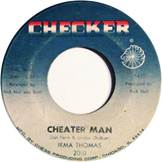
The track “Cheater Man”, co-written by Dan Penn and Spooner Oldham, was released in 1967 to test the market, but there was no big breakthrough. Two further tracks appeared as single releases in 1968, “A Woman Will Do Wrong” and a cover of the Otis Redding song “Good To Me”.
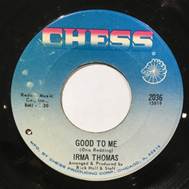
The last of the three did enter the Billboard R&B Singles Chart, but Chess were not happy with the results and Thomas moved on to California. The plans for an album release were dropped.
The ten remaining tracks stayed in the vaults at Chess Records until 1984, when an album of the Muscle Shoals songs, featuring twelve tracks, was released in Japan (Chess, P-Vine Special).
In 1990, Chess/MCA Records released another compilation of the Muscle Shoals songs, featuring fourteen tracks. The extra track is an alternate mix of “We Got Something Good”. The compilation is called “Something Good/The Muscle Shoals Sessions”.
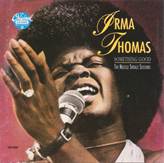
Just to complicate things, an extended version of the Japanese album was released in Europe in 1991, with all thirteen songs included (Chess, Charly Records). The album is presented as a compilation, entitled “Down At Muscle Shoals”.
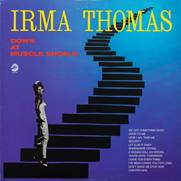
The FAME session band who played with Irma Thomas were David Hood and Tommy Cogbill, who shared bass duties, Roger Hawkins on drums, Jimmy Johnson on guitar, and Spooner Oldham on keyboards. The horn section included some later members of the Muscle Shoals horns. Rick Hall was in charge of production.
The track listing begins with the three single releases. “Cheater Man”, the Dan Penn/Spooner Oldham composition, has a strong Memphis feel. Track two “A Woman Will Do Wrong”, written by Paul Kelly and Clarence Reid, is a slow ballad, featuring a harmony vocal and a strong sax line. For the third song, “Good To Me”, Thomas sings with more expression, but Otis is a hard act to follow! Thomas’ version starts with a low-key horn intro, with a soft, tender vocal. The romantic feeling is heightened by the angelic backing voices, the smooth horn section and the gentle tempo set by the drums. The song slowly gathers pace and builds to its crescendo.
The previously unreleased tracks start with “We Got Something Good”. This is one of the strongest songs on the album, written by Maurice Dollison, with an up-tempo, bouncy tune and punchy horns. Track five is another Penn/Oldham song, “Let’s Do It Over”, a good example of Muscle Shoals Soul, which suits Thomas’ voice more than some of the others on the album. “I Gave You Everything”, written by Larry Hamby and Terry Woodford, demonstrates this well. Thomas tries to add a rough edge to her voice, but the result is not convincing.
Track seven, “I’ve Been Loving You Too Long”, is another Otis Redding song, co-written with Jerry Butler. Thomas follows the original closely, and the session band provide a solid backing, but, as before, Otis’ version is just unbeatable. “Security”, the next track, repeats the pattern, with more success. Thomas is more at ease with the tempo. Track nine is “Somewhere Crying”, written by Oliver Sain Jr. It was the B-side of the “Cheater Man” single. It is a Deep Soul ballad, one of the best songs on the album, which shows Thomas’ voice at its best and illustrates the strengths of the rhythm and horn sections. It also features Spooner Oldham on organ, adding his signature sound, which is a key aspect of the Muscle Shoals sound. The next track “Don’t Make Me Stop Now” is another song which suits Thomas’ voice. She softens her delivery and stresses the romantic nature of the lyric. For track eleven Thomas chose another Penn/Oldham song entitled “Good Things Don’t Come Easy”, followed by “Here I Am, Take Me”. Both are typical Muscle Shoals Soul songs. The thirteenth song recorded at the 1967 sessions is “Yours Until Tomorrow”, written by Goffin and King, another slow ballad.
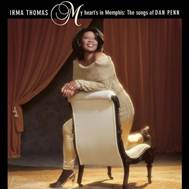
Thirty-two years after the FAME sessions, Irma Thomas made another Southern Soul album. It was recorded in Memphis at Sounds Unreel in September 1999. The subsequent album, “My Heart’s In Memphis”, is a collection of Dan Penn songs, all written with various collaborators, including Spooner Oldham, Donny Fritts and Irma Thomas herself. It was released in 2000 by Rounder Records. It is a Memphis album, but the memory of Muscle Shoals is evident. Certainly, the relaxed style of the songs and Thomas’ softer delivery are a long way from Memphis and much nearer the Shoals’ sound. In 1967 Irma Thomas was still young and learning the trade. In 1999 she sings with confidence, in a lower register. The rather shrill vocal lines of some of the earlier songs, where Thomas seemed to be forcing things, are now smooth and easy.
Looking back, Irma Thomas and Muscle Shoals were a very good match!