
Dootone Records began operating in 1951, having been set up as Blue Records in 1949. Its founder was Dootsie Williams, who came to Los Angeles as a child in 1918 from his hometown Mobile, Alabama. He played the trumpet; during the early 1940s he fronted a band called Dootsie Williams and His Chocolate Drops. Later, he led the Harlem Dukes, before joining Roy Milton’s Solid Senders. He also worked as a talent scout for MGM, attracting performers including Ivory Joe Hunter and Big Joe Turner, before deciding to try his hand as a record producer with his own company.
As a performer, Williams had first-hand experience of just how badly some performers were treated by record companies, especially with regard to receiving a fair reward for their endeavours. Music of Black origin was often treated as less important or was re-recorded by White artists to ensure a greater chance of success. He determined to become his own boss and to promote Black artists:
“[T]he desire to be in business, to be independent, to be my own boss — was the first step, the first key factor, in [my] success story.”
“For years I watched record firms steal the arrangements and music of Negro artists and musicians and reproduce it in a manner which was not fitting to the music. Although the firms exploited the music they did not give proper credit to the people from which they had taken it.” (Source: Before Motown: L.A.’s Black-Owned Soul Music Empire, Robert Peterson 2021).
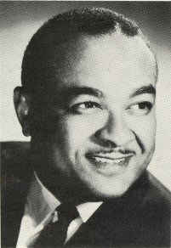
Dootsie Williams (Wikipedia)
Blue Records had a very small roster of artists. The initial releases were recorded by just three singers: Billy Mitchell (nine singles issued), Hattie Noel (three singles issued) and Violet Hall (one single issued). Mitchell and Noel also recorded one single together. All fourteen of these releases were comedy songs, laced with bawdy double-entendres and backed by a jaunty piano accompaniment. They were an echo of the dirty Blues that developed in the late 1920s. Later, a small number of Jazz and R&B tracks were recorded by other artists, including Bobby Nunn and Bumps Myers, with a label headed Blu Records.
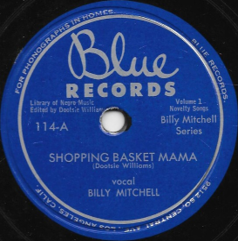
The change of name in 1951 also brought a change of emphasis for Williams’ company. He continued to record some comedy tracks but now added Jazz, Gospel, Blues and R&B to the repertoire. For the first few years, the operation was conducted at Williams’ home address, 9512 South Central Avenue, in Watts, with the family in residence. Later, he and his family moved to a new home and the old house was used as the company’s headquarters.
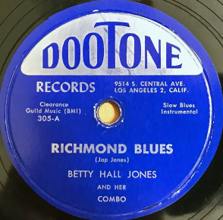
The new label began a new 300 series for singles, which ran from 301 to 409, initially on 10” shellac discs and then on vinyl 7”. Albums were usually on a 200 series, with significant variations. The colour of the label was also variable, changing from blue to red or yellow.
The early recordings from 1951-2 featured two singles by Johnny Creach (who later played with Jefferson Starship), a slow Blues piano instrumental by Betty Hall Jones (see above), and a couple of singles from Boogie Woogie maestro Pete Johnson, one with Big Joe Turner. Piano and saxophone are very much to the fore.
By 1954, tastes had changed. The music was more up-tempo, and orchestras were replaced by small vocal harmony groups and combos. The Medallions’ “Buick 59” is typical of the new R&B sound; it is Black Rock & Roll. The Medallions, led by teenager Vernon Green, had hits with “Buick 59” and “Speedin’”.
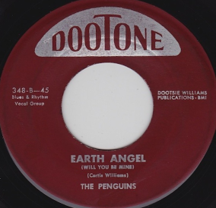
Alongside the fast dance tracks a slower style had also developed, typified by the Penguins’ “Earth Angel”; their romantic ballads with soft harmonies were heading for Doo-Wop. “Earth Angel” was a major cross-over hit in 1954, one of the first!.
In 1955, Don Julian and the Meadowlarks had a hit with “Heaven And Paradise”. It is smoother with stronger vocals; the harmonies are richer and more sustained. The success of these vocal harmony singles encouraged Williams to recruit more groups who would deliver this sound. The Pipes, the Saigons, the Crescendos, the Romancers, the Calvanes, the Cuff Links, the Silks, and several more similar groups all came to Dootone. Williams also put together a group called the Dootones in 1955, but they released just one single that year. One of the Dootones was a young man R. B. Barnum. He would go on to become a top arranger on the West Coast and beyond. From 1970 to 1974 he worked with the leading acts at Motown (including Diana Ross & the Supremes, Junior Walker & the AllStars, Gladys Knight & the Pips, the Originals, and Smokey Robinson & the Miracles) and also at Invictus and Hot Wax with Freda Payne, Chairmen of the Board and 100 Proof (Aged In Soul).
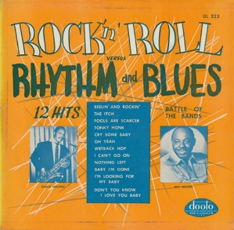
Meanwhile, the R&B was not being neglected. Roy Milton came to the Dootone label from Specialty in 1955. He recorded a couple of singles, “You Got Me Reeling and Rocking”/ “Nothing Left” (1955), and “Cry Some Baby”/ “Baby I’m Gone” (1956). Another arrival from Specialty was Chuck Higgins, with his band and his saxophone. They recorded a series of singles in 1955 in a R&B swinging style, featuring some honky-tonk piano and some typical LA saxophone. In 1959, Dootsie Williams put out an album linking the two performers. He called it “Rock’n’Roll versus Rhythm and Blues”.
Willie Headen came to Dootone in 1954. He had started out as a Gospel singer in Austin, Texas, but came to Los Angeles in the early fifties to sing the Blues. While waiting for his big break, he was working shining shoes, when Dootsie Williams heard him singing as he worked. He soon cut his first single!
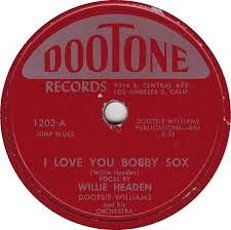
Headen cut a dozen more tracks that were released on Williams’ various labels but never made it into the national charts. In 1960, a compilation entitled “Blame It On The Blues” was issued by Williams, which was remastered and re-issued by Ace Records in the UK in 2006. It is an excellent collection of West Coast Blues and R&B.
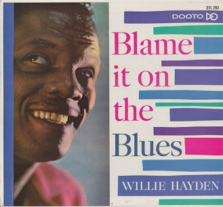
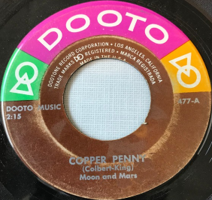
In 1957, Dootsie Williams was forced to change the name of his main label in order to avoid being taken to court by Duo-tone Records. He chose Dooto Records as the new name. The numbering of the discs continued the series set up for Dootone and the genres covered remained the same, reflecting the old Race Records series of the pre-war era. Gospel was represented by the Lillian Randolph Singers, the Zion Travelers, and the Soul Revivers. On the Jazz front, Black pianist Carl Perkins, Curtis Counce, Dexter Gordon and Buddy Collette joined the label.
In the mid-fifties, Williams returned to where he had started. His most successful artist during this period was Redd Foxx, a comedian who recorded a series of albums of his stand-up routines, following the same bawdy route taken by the performers on Blue Records.
Williams also set up an auxiliary label for Dooto, which he named Authentic. Around thirty records were issued on the subsidiary during 1956 and 1957, featuring most of the Dooto artists.
Thanks to the success of his recording business, Williams was able to make a significant contribution to his community. In 1962, he opened the Dooto Music Centre, which he had commissioned. It offered spaces for concerts, dances, and other social and political events, as well as providing educational opportunities for children from the local area. In 1959, he set up a film and television production company (over ten years before Berry Gordy did the same thing!) but found it hard to break into that industry. Instead, he devoted his time more and more to running the Dooto Centre.
Looking back over his career in the recording industry, Williams was clearly proud of his achievements:
“There is a wealth of talent among Negroes. This talent, this gift, this ability is, in my opinion, unsurpassed. But not always has this talent of the Negro been given an opportunity to express itself to capitalize on its value in the open market of American competition. We have striven to remedy this situation.”
Dootsie Williams died in Los Angeles in 1991.
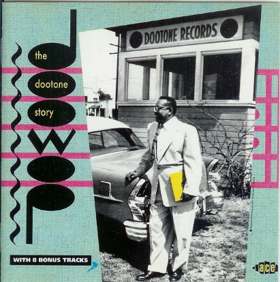
In 1992, Ace Records UK released a CD, “The Dootone Story”, featuring twenty-two tracks that represent the best of the labels output.
Ace Records’ 1992 Compilation