
The follow-up studio album, after the anthology album “Looking Back” (1977), was “Stevie Wonder’s Journey Through The Secret Life of Plants”, the first soundtrack album of his career, released in 1979. It was based on the book of the same name written by Peter Tompkins and Christopher Bird. The album can be described as a soundtrack documentary relating to plant life. The album only produced one major hit single, “Send One Your Love,” which topped the Billboard Adult Contemporary Singles Chart week-ending 22nd December 1979 (2 weeks). The single features Stevie Wonder on vocal, and Ben Bridges and Rick Zunigar on guitars. It is a very slow tempo track, with Rick Zunigar playing standing bass, and Ben Bridges playing rhythm acoustic guitar. Wonder also plays the drums on the track. This is a very relaxing track compared to many of his previous recordings, similar in tempo to “You Are The Sunshine of My Life”. The track was recorded at the famous Sigma Sound Studios, Philadelphia, PA, known for “The Philadelphia Sound.” The beginning of the track features voices of people that explode into a funky jazz fusion number, in a style that was extremely popular during the 1970s. You can hear a funky bass line, with a Vocoder voice box used in the middle of the track and a choir of beautiful voices singing in the background.
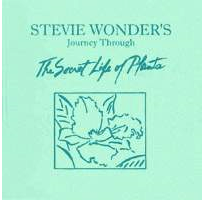
In his Rolling Stone article reviewing the album (24th January 1980), Ken Tucker gives some unusual advice: “Begin at the end. Stevie Wonder’s “Journey through the Secret Life of Plants” is so uneven, so full of tiny pleasures and bloated tedium, that for some assurance that Wonder hasn’t lost his touch, you ought to start by listening to the LP’s last cut. “Finale” commences with a quick, slapstick keyboard fill and then expands into an undulating instrumental whose billowing bass and synthesizers evoke a quivering field of flowers in bloom. Not only that, but the song works on an additional level as a sly parody of the kind of sweet bombast associated with silent-film melodramas.” The track closes with sound effects and the sound of a bird.
Sadly, the album was a commercial failure in America compared with Wonder’s four previous studio albums. However, the album did extremely well overseas, especially in the UK, where it received tremendous support. On 30th October 1979, the album was awarded gold certification for 100,000 copies sold, according to the BPI. It peaked at number eight on the UK Official Albums Chart week-ending 10th November 1979 (1 week).

The single “Send One Your Love” performed well in Canada, where it reached number seven on the National 100 Singles Survey (RPM Singles Chart) week-ending 12th January 1980. On the Cash Box Pop Singles Chart, the Billboard Hot 100 Singles Chart, and the Billboard Hot Singles Chart in the USA, it went to numbers five, four, and five..
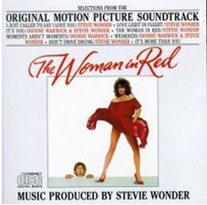
After Wonder’s successful run at the top with the album “Stevie Wonder’s Original Musiquarium I,” he had a quiet year, then re-emerged in 1984 with a soundtrack album entitled “The Woman in Red,” which once again brought him international success.
The soundtrack album was an enormous success on both sides of the Atlantic. It obtained platinum certification in America on the 8th November 1984 according to the RIAA for over one million copies sold. In the UK, the BPI awarded the album multi-platinum status for sales in excess of one million copies on the 10th September 1985. By the mid-1980s Stevie Wonder was at the top of his game in terms of commercial success and was regularly adding more entertainment industry awards to his growing collection.
The soundtrack reflects the popular sound of that period with great emphasis on the use of synthesizers, drums, and various percussion instruments, with the addition of some horn instruments on occasions. “Love Light in Flight” consists of Stevie Wonder playing synthesizer and drums and Lenny Castro playing congas. On “Woman in Red” Wonder plays the synthesizer and drums, sings lead and background vocals with other background vocalists. Another track of interest which he recorded with Donnie Warwick as a duet is entitled “Weakness,” which sounds like a classic soulful performance of the 1970s with a combination of lush strings, synthesizers played by Wonder and Isaiah Sanders and a saxophone solo by Philadelphia-born session musician legend Bob Malach. He recorded the beautiful track “It’s You” with Dionne Warwick. The string arrangements were written by Jeremy Lubbock, a British classically-trained musician, songwriter, producer, and pianist. It is a song worth listening to, which highlights Miss Warwick’s rich, polished and mature voice. The “Woman in Red” album was platinum-certified for one million plus sales in America awarded by the RIAA in 1984. In England Wonder received another platinum plaque in 1984 for over 300,000 copies sold.

The soundtrack album features one of Wonder’s biggest hit singles across the world. “I Just Called To Say I Love You” topped the Billboard charts on several singles listings: the Billboard Hot 100 Singles Chart week-ending 13th October 1984 (3 weeks), the Cash Box Pop Singles Chart week-ending 13th October 1984 (4 weeks), the Billboard Hot Black Singles Chart week-ending 13th October 1984 (3 weeks) and the Billboard Adult Contemporary Singles Chart week-ending13th October 1984 (3 weeks). In the UK, the single peaked at number one on the Official UK Pop Singles Charton 8th September 1984 (6 weeks). It also went to number one on the Irish Pop Singles Chart week-ending 8th September 1984 (5 weeks). In addition, the song made it to number one on singles charts in several other European countries that year!
Stevie Wonder played all the instruments on the single: synthesizer, drums, vocoder, and organ. Once again Wonder creates a rich sound as the only musician on the track, with the support of his long-serving sound engineer Gary Olazabal, who was also associate producer, with additional assistance and technical help from Bob Harlan and Olivier de Bosson as sound engineers working at the Wonderland Sound Studios where the entire album was recorded. Together the engineers and Stevie Wonder managed to produce a sound which was a mixture of Contemporary Pop and Soul with an urban touch, elegant, smooth, sweet, and romantic at the same time. It was a typical recording of the 1980s in some ways, but uniquely Stevie Wonder too. The track was a worldwide smash and reached the top of the charts in many countries, including Australia and New Zealand.

After two successful studio albums, once again Wonder recorded an entire soundtrack called “Jungle Fever,” co-produced with his tour band leader Nathan Watts. It was released on 28th May 1991. The album obtained gold certification in America in 1991 for over half a million copies sold. “Jungle Fever” the movie, directed by African American Spike Lee, did very well at the box office and grossed over $40 million. The album peaked at number one on the Billboard Soul and R&B Albums Chart week-ending 3rd August 1991 (2 weeks). It performed extremely well against other Black soundtrack albums such as “Boyz n the Hood” and “New Jack City,” all produced and directed by African American film makers.
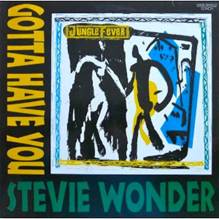
The first single released from the “Jungle Fever” soundtrack bought Wonder back into the winning circle with its funky groove. “Gotta Have You” features a more Blues-infused lead vocal melody line through the whole song, similar to his performances during his golden era of the 1970s. The song was mixed by another long-serving staff member at Wonderland Studios, sound engineer Steve Van Arden, who worked with Stevie Wonder on the “In Square Circle,” “Characters” and “Conversation Peace” albums. “Gotta Have You” captures the mood of the film “Jungle Fever,” focusing on relationships during the 1990s in inner cities such as New York City and Chicago. The song’s musical fusion is made up of Urban and Contemporary R&B, with elements of New Jack Swing and Pop-Soul.
Stevie Wonder was clearly not afraid to try new things!

This is an artistic interpretation of Stevie Wonder performing live by Kevin Tomlin, music historian, artist, and author.