
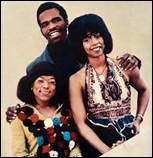
The Undisputed Truth was a group created by Norman Whitfield to explore new ideas relating to the Psychedelic Soul songs that he was recording with the Temptations and other Motown artists. Two of the group’s members, Billie Calvin and Brenda Evans, had sung together in the Delicates, a band based in Los Angeles that broke up in 1970. They came to Motown at the suggestion of Bobby Taylor, where they found employment as backing singers. They can be heard on Diana Ross’ version of “Ain’t No Mountain High Enough”. Norman Whitfield was looking for singers to form a new group to work with him and wanted in particular to explore combinations of male and female harmonies. He liked the vocal qualities of the two girls, so needed a male vocalist to complete the group. He chose Joe Harris, who had been a member of the Detroit band the Fabulous Peps up to 1968. Visually, the Undisputed Truth looked the part, with large Afro-style hair and unusual make-up to go with flowing costumes. They were assigned to the Gordy label.
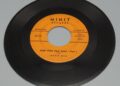
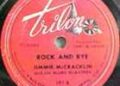
Norman Whitfield used the group to experiment with different versions of many of the songs that he had written, usually with Barrett Strong. This meant that the Undisputed Truth were immediately busy in the studio. The results came with the release of an album, “The Undisputed Truth”, in July and three singles, in March, June and December. The first single “Save My Love For A Rainy Day”/ “Since I’ve Lost You” reached number forty-three on the Billboard R&B Singles Chart. It is not particularly experimental. The second single “Smiling Faces Sometimes”/ “You Got The Love I Need” made a bigger impact, peaking at number two on the Billboard R&B Singles Chart and number three on the Billboard Hot 100 Singles Chart, week-ending 4th September 1971. It spent six weeks in the Top Ten and also had further success on the Cash Box Pop Singles Chart, going to number one, week-ending 18th September 1971 (1 week). It was also number one on the Cash Box R&B Singles Chart week-ending 28th August 1971 (1 week). It was a brilliant performance by the group, under Norman Whitfield’s creative leadership. The arrangement has some interesting harmonies and a more psychedelic feel thanks to Jerry Long. The B-side is a good Northern Soul dance track.
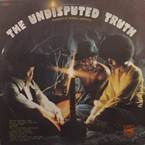
The album soon followed, with a July release and good sales that took it to number forty-three on the Billboard 200 Albums Chart and number seven on the Billboard R&B Albums Chart. It features five songs co-written by Whitfield and Strong, one from Whitfield and Penzabene, one from Whitfield, Moy and Grant, one from Holland, Dozier, Holland and one from Ashford & Simpson. The two non-Motown tracks are covers of “Aquarius” and Bob Dylan’s “Like A Rolling Stone”. “The Undisputed Truth” was produced by Norman Whitfield, with arrangements by Paul Riser (tracks 2 and 3) and David Van DePitte (all other tracks).
Norman Whitfield’s experiments took two forms. Sometimes he would take an old song and rework it, or else he would take a new song and try out a version with the Undisputed Truth, before recording a different version with another group, usually the Temptations. This album is an example of the first approach, with only one new song “You Got The Love I Need” (which used an old backing track from 1965!) and eight Motown songs that had been recorded by other acts, including Marvin Gaye and Gladys Knight & the Pips.
The group’s final release of the year was the single “You Make Your Own Heaven And Hell Right Here On Earth”/ “Ball Of Confusion (That’s What The World Is Today)”, which combines a B-side from “The Undisputed Truth” album with an A-side from the sessions for the next album “Face To Face With The Truth”, which appeared in January 1972. The B-side is a twelve-minute Psychedelic Soul version of the Temptations’ hit, with the A-side another typical Whitfield Psychedelic Soul opus that only lasts five minutes fifty-eight seconds. It is their best single so far.
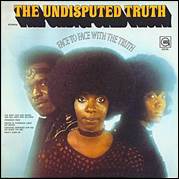
The “Face to Face With The Truth” album charted at number sixteen on the Billboard R&B Albums Chart and number one hundred and fourteen on the Billboard 200 Albums Chart. It remained on this chart for twelve weeks. The entire album was once again produced by Norman Whitfield, featuring two new songs and five covers of songs originally recorded by the Temptations, Gladys Knight & the Pips, the Four Tops or Marvin Gaye. Five of the tracks on the album were co-written by Whitfield and Strong, with the remaining tracks in capable hands. The two non-Whitfield tracks are “Take Me In Your Arms and Love Me”, co-written by Barrett Strong, Cornelius Grant and Roger Penzabene, and “What’s Going On”, the work of Benson, Cleveland and Gaye. Whitfield produced each of the covers completely differently from the original recordings.
The album features members of the Funk Brothers rhythm section, with no added strings or horns. There is a strong team of five guitarists involved, the “old guard” of Joe Messina, Eddie Willis and Robert White, plus the newcomers Dennis Coffey and Wah Wah Watson adding their psychedelic touches. Also well-represented are the Motown percussionists, including Eddie “Bongo” Brown, Jack Brokensha, and Jack Ashford, supporting drummers Aaron Smith, Andrew Smith and Richard “Pistol” Allen. The studio band was completed by three stalwarts, Johnny Griffith on organ, Earl Van Dyke on piano and James Jamerson on bass. The songs cover a range of styles from R&B to Soul and Psychedelic Soul, with love songs mixed with songs dealing with social issues. It was not unusual to see Norman Whitfield master-minding the recording process and here, once again, he carried out the mixing and mastering with Orson Lewis.
The opening track on the album “You Make Your Own Heaven and Hell Right Here on Earth” had been released as a single in December 1971 and was now climbing the charts, peaking at number seventy-two on the Billboard Hot 100 Singles Chart and number twenty-four on the Billboard R&B Singles Chart. In February, the album’s second track “What It Is” was also issued as a single by Gordy, backed by the Ashford & Simpson classic “California Soul”. It maintained the group’s level of chart success, reaching number seventy-one on the Billboard Hot 100 Singles Chart and number thirty-five on the Billboard R&B Chart. It is a fast-paced up-tempo track with vocal leads shared between the group’s three members at different points in the song.
Musicians featured on the track were Aaron Smith on drums, Dennis Coffey on lead guitar, and James Jamerson on bass. The single features a lot of rhythm guitar riffs centred around Dennis Coffey’s funky performance, accompanied by Eddie Willis, Joe Messina, Robert White, and Wah Wah Watson. The track is dominated by all the rhythm guitars, with the bass, percussion, and keyboard instruments mixed down. Whitfield used a lot of studio sound effects at the end of track and added some hand clapping, but unfortunately the track does not in my view come up to the sonic quality of the previous single “You Make Your Own Heaven and Hell Right Here on Earth”, which has more drama and depth to the narrative.
The rest of 1972 was busy with the move from Detroit to Los Angeles. The group had no more releases until the following year.