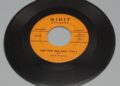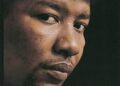

Leona Rupe founded Ebb Records with the help of Jesse J. Jones in 1957. She funded the operation with the money she received as a settlement following her divorce from Art Rupe, the owner of Specialty Records. She had worked at Specialty in support of Art and had learned about the music business, having previously worked for the Max Factor cosmetics company in Hollywood. She could be the second female record label owner, following Vivian Carter at Vee-Jay Records in Chicago.
Leona Hanson, known as Lee, was born in 1922 in Bemidji, Minnesota, Her family came to Los Angeles in the early forties. She later married Harry Apostoleris and moved to New York, where she continued to work in the music industry. She died in 2017.
At Ebb Records Leona Rupe built up a roster of over thirty acts, concentrating on Blues, Doo-Wop, R&B, Rockabilly, Rock, and Pop recordings. The list of artists includes Black and White performers. The label released between sixty and seventy singles from 1957 to 1959, achieving a few local successes but only one national hit, “Buzz-Buzz-Buzz” by the Hollywood Flames. When Ebb ceased trading in 1959, Leona set up a new label, Mona-Lee Records, which released another dozen or so singles between 1959 and 1968, plus a couple of albums.
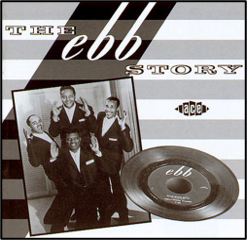
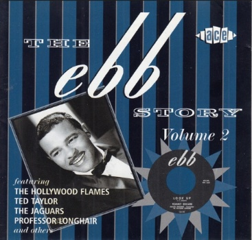
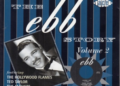
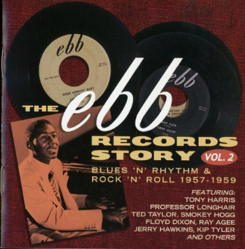
Ace Records UK put together an excellent compilation of Ebb Records’ best tracks in 1995, which contains thirty-one tracks. They called it “The Ebb Story”. A second volume followed in 1998, offering another thirty tracks.
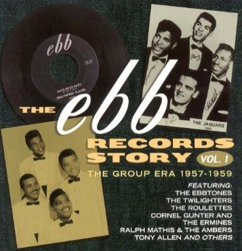
These two albums may have inspired the two-part compilation from Specialty, which appeared in 2001, offering fifty-nine tracks, and called “The Ebb Records Story”.
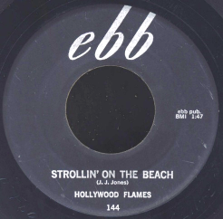
The Hollywood Flames were the most successful of the Ebb artists, achieving the label’s only national hit with their single “Buzz-Buzz-Buzz”, a party dance track with a Doo-Wop backing and a foot-tapping saxophone solo from 1957. The company released six more singles by the quartet during 1958 and 1959, the best of which is “Strollin’ On The Beach”, written by arranger and horn player Jesse J. Jones, who also recorded at Ebb in his own right as leader of the J.J. Jones Combo.
Several more of the Ebb acts were Doo-Wop vocal groups, including the Ebbtones, the Tempo-Mentals, the Roulettes, and the Georgettes. The best of the Doo-Wop releases came, however, from the Ambers, a group that included Ralph Mathis, Johnny’s brother. Their single “Never Let You Go” is irresistible.
There was a New Orleans influence at work too. Two singles from Professor Longhair and one from Robert Willis demonstrate the typical bouncy piano of the Crescent City. Floyd Dixon follows the example of Little Richard with “Ooh Little Girl”.
The Rockabilly output came via the Twilighters, Gene Wyatt, John Stone, and Jerry Hawkins.
Most of the Ebb releases were dance tracks, with several moving in the direction of R&B and others heading to Rock & Roll and the Pop Charts. Amongst the R&B tracks are a couple of funky instrumentals, “Geechi”/ “Huggin’” from Little Jesse and “Wild Man Walk”/ “All Alone” from the Ebonettes. Both feature strong piano and saxophone contributions.
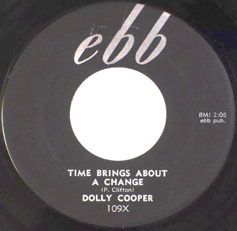
There is just one Gospel single in the collection, “Beautiful City”/ “Believe In Me” by the Zion Travelers, who also recorded for Aladdin and Dootone/Dootoo. It is beautifully sung in Sam Cooke’s Soul Stirrers style. One other track also has a strong Gospel influence. It is “Time Brings About A Change” sung by Jazz singer Dolly Cooper. It is a slow Blues with Jazz and Gospel inflections, totally suited to Cooper’s powerful voice. It was released in 1957.
The final group of artists are the Blues singers, Smoky Hogg, Ted Taylor, and Tommy Lamkin.
Smoky Hogg made his first recording at Decca in 1937. He came to Modern in Los Angeles in 1948, releasing seven singles in two years. He subsequently recorded for a variety of labels, some on the West Coast (Specialty, Imperial, and Combo) and some further afield. In 1958, “Sure ‘Nuff”/ “Good Mornin’ Baby” was issued by Ebb. His voice is quite raw, but it suits the funky style of the songs. The driving harmonica is an unusual feature.
Ted Taylor has a sweeter voice, often in quite a high register. Piano and guitar are to the fore on his recordings. “Keep Walking On” from 1958 is a Blues ballad aimed at the Pop market, “Wrapped Up In A Dream” is a romantic ballad, but Taylor also recorded more traditional Blues. The best track is “Days Are Dark”.
Tommy Lamkin made just two singles in his career, one for Imperial in 1955 and one for Ebb in 1957. The Ebb tracks, the up-tempo “Three Minus One” and the slow “The Weather’s Stormy”, both feature orchestral backing and Lamkin’s soaring falsetto.
Mona-Lee Records
When Lee Rupe shut Ebb down, she switched to a new label, Mona-Lee. It ran from 1959 to 1962, with two further recordings appearing in 1968. The only hit for the Ebb label, the Hollywood Flames’ “Buzz-Buzz-Buzz”, was re-issued in 1959. Around a dozen singles were released during the three years of operation, covering a similar range of genres to the Ebb output.
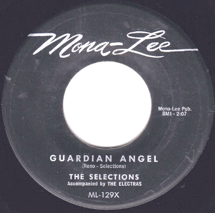
Early releases included “Lonely, Lonely Heart” by Jimmy Reagan And The Rhythm Rockers and “Guardian Angel” by the Selections, which had already been released by Antone Records.
Several of the other Mona-Lee singles also appeared on other labels, including “Guardian Angel” by the Imaginations (The Selections by another name?), which was issued by Duel, Bo Marc, and Bayou Records. The owner of the last of these was Emmet Spinks, who produced the recording, probably in Texas where Bayou was based. Lee Rupe may have licenced this track and others.
The two 1968 releases are from the Flower Power era and were almost certainly recorded in New York, where Lee was living with her new husband Harry Apostoleris.