
Selective was a Los Angeles label set up in 1949 by John Blackburn. It lasted less than a year but put out around twenty singles in that short time. All releases were 10” 78rpm shellac discs.
John Blackburn was a well-known lyricist who composed “Moonlight In Vermont”, which was recorded by Nat King Cole with Johnny Miller (bass) and Oscar Moore (guitar) for Capitol Records in 1947 (released in 1949). The song has been covered many, many times since, and may have helped fund Selective!
The artist roster was quite short, with a dozen acts. They included three Country singers, a Jazz guitarist, two Gospel groups, and eight R&B acts, including vocal groups, a Boogie-Woogie pianist, and solo singers. All the genres from the pre-war Race Records era are represented. Only the R&B recordings are covered here.
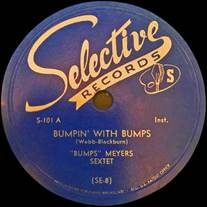
Hubert “Bumps” Myers was born in Virginia in 1912 but came to Los Angeles during his childhood. He was a tenor saxophonist who played in many well-known Jazz bands, before turning his hand to the emerging R&B styles. He played in studio sessions with T-Bone Walker and signed for Selective in 1949. Two singles were released that year, “Bumpin’ With Bumps” and “Memphis Hop”, by the “Bumps” Myers Sextet (Note: his name is spelt with an extra e on the first single). Both singles show how Jazz and Blues were merging into R&B.
Myers later recorded for RPM and Blu, as well as playing on many sessions for producer Maxwell Davis during the nineteen fifties, including several with Percy Mayfield.
Edward Gates White, otherwise known as the Great Gates, also cut two singles at Selective. “Late After Hours” is a well-known instrumental written by Jazz pianist Avery Parrish, to which Gates added lyrics. He took the song to number six on the new Billboard R&B Singles Chart.
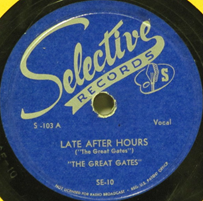
His second single is more up-tempo. “Race Track Blues” is a Jump Blues, featuring a good saxophone solo.
Teddy Bunn was born in1909. By the end of the twenties he was playing acoustic guitar with various bands. Ten years later, he started to play electric guitar and made his first recording for Exclusive. In 1949, he recorded several tracks for Selective, including “Irritatin’ Blues”, “One A.M. Blues”, and “I’ve Come A Long Ways Baby”. The first two have a strong Jazz influence, but the third is a genuine R&B Blues, which demonstrates Bunn’s single-note technique. It is a style of guitar playing that became popular on the West Coast.
Madonna Martin had a short visit to Selective, with just a few tracks recorded while she was in Los Angeles on tour with Louis Armstrong. Fortunately they are good ones. “Rattlesnakin’ Papa” is a Boogie Woogie Jump Blues, full of energy. “Madonna’s Boogie” is even better, with a strong vocal and lively piano backing.
The Flames offer a Pop ballad, “Please Tell Me Now”, in their own name and also provide the vocals for Peppy Prince And His Sugar Men’s “Sugar Man”. Peppy Prince was a drummer in Joe Liggins’ band. He recorded for Miltone in 1947 and at Selective in 1949. “Sugar Man” is an orchestral R&B song.
The Rhythm Riffers were a group of teenage musicians who played as the backing band for the Great Gates between 1949 and 1951. They played on the Great Gates songs highlighted above. While at Selective John Blackburn gave them the opportunity to record a couple of instrumental tracks, credited as the Rhythm Riffers. “Fandango” takes a little while to get going but then highlights each member of the group in a rocking R&B dance track.
The next artist at Selective is Dallas Red. He recorded two Percy Mayfield songs in 1949, “Alma Lee” and “Cold Blooded Blues”. As soon as you hear the voice, you know that Dallas Red is actually Percy Mayfield, fresh from making his first two singles at Gru-V-Tone. However, the style of the two Selective tracks is a little different from Mayfield’s usual approach. His best songs are ballads, but “Alma Lee” and “Cold Blooded Blues” are typical of the Blues shouters such as Big Joe Turner.
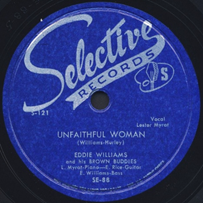
Eddie Williams And His Brown Buddies came to Selective from Supreme, where they had recorded five singles in 1949. They made just one single for John Blackburn, issued in June 1950, featuring two Los Angeles slow Blues.
This was the final issue by John Blackburn’s label. It was shut down later in 1950, possibly for financial reasons. Selective had just one national hit and that probably wasn’t enough to fund the label any more.