
The decision to move the Motown Corporation headquarters to Los Angeles was made public on 14th June 1972. The decision was announced to staff in the Donovan Building in Detroit by recently-appointed General Manager Amos Wilder and it appears to have come as a shock to some of the artists, session musicians, engineers, and office staff.
On 17th June, an article appeared in Billboard magazine, written by Claude Hall, headed “Gordy Labels to Coast HQ”. At first it seems to downplay the impact of the move: “Several of the staff members will be shifted to the Los Angeles”. Later, it becomes clear that Detroit is no longer to be key to the operation: “At this time, according to Robert Gordy, head of Jobete Music, the publishing firm will stay in Detroit, where a skeletal staff will also be maintained in the record division”. The article also makes it clear that sales and marketing are to be switched to Los Angeles, with Phil Jones in charge of that division, and that the change is happening immediately: “Phil Jones will be in total charge of sales, starting this week from Los Angeles”.

Claude Hall
Source: Dan O’Day’s website
That seems clear enough, but then Claude Hall quotes a press statement from Motown Vice-President Mike Roshkind that seeks once more to minimise the whole story: “…expanding motion picture activities and other West Coast interests will draw some of our manpower from Detroit. But any move is absolutely rumor at this time. I’m not sure myself what the details of the move will be.” It is no wonder that staff at Motown were confused!
Claude Hall finishes his article with a review of the management changes that he already knows about. Barney Ales, who had been such a key figure in building the business in the early days, was resigning. He wished to stay in Detroit. His replacement as General Manager was Amos Wilder, who had made the 14th June announcement to Motown staff. Also leaving were some of Ales’s colleagues, including Chuck Young, Al Valenti, Gene Scurty, and Kevin Cummings. Two other key figures in the management team, Gordon Prince (Head of Record Promotion) and Joe Summers, had made it known that they would shortly be transferring to the West Coast.

Source: Wikimedia Commons
Thanks to Woodward, a Senior Member of the Soulful Detroit website, it is possible to read an article in the Detroit Free Press newspaper from 9th June 1972, that was written by Staff Writer Chuck Thurston. The article appeared five days before the official announcement! Thurston was in Detroit and he must have had good contacts at Motown. He certainly understood what was happening a lot better than Claude Hall! The article is headed “Motown Exiting City A Little At A Time” and it starts with total clarity:
“Half of Motown Records, Detroit’s rock musical pride and joy, has already left town and if the present trend continues, there won’t be more than a handful of people left tending the local store by the end of the summer — if there are any at all.”
Thurston goes on to report that news of Barney Ales’ retirement had broken the Thursday before, and that the Sales department that Ales had built up would now be split between several cities. The diversification programme envisaged setting up five Sales Offices, in Los Angeles, New York, Atlanta, Chicago and Philadelphia. He also reports that John Britton, Motown’s Head of Public Relations, was already in Los Angeles.
He quotes a nameless Motown official who stated that the number of staff still based in Detroit will reduce from around three hundred to fewer than one hundred by mid-July, tasked with running the operations that would remain in Detroit: the tape library, the publishing facilities, a personnel office and a small team linked to the main creative, financial and shipping divisions in Los Angeles. Finally, he confirms that Fuller Gordy (Head of Administrative Services) and Esther Gordy will remain in Detroit, with the transfer of all the key staff expected to be completed by 15th July. His final words at the end of the article sum up what a lot of the Motown staff must have been thinking around this time:
“No one at Motown knows, or is willing to guess, how much of Motown, if any, will still be here after October.”
It is likely that all the senior managers knew what was coming. They were expected to make the move to California. For the office staff, artists, engineers, producers and songwriters, things were less clear. Some were offered jobs in Los Angeles, but many were laid off. Some decided to join the exodus heading west, but many wanted to stay in Detroit. They had to find a new work-place. For a lot of the studio musicians who were paid by the session, there was no protection and no right of transfer to Hollywood. They had to move on, to other Detroit studios or further afield. After thirteen years, the team that had been built around the Funk Brothers was being dismantled. Could Motown really be the same without them?
The move to Los Angeles took several weeks to complete, but by the end of the summer, the Donovan Building had been abandoned. Berry Gordy actually retained ownership of the building for some time after the company’s departure; there were later discussions regarding the setting up of a Motown Museum at both Hitsville and Donovan, but in the latter case they came to nothing. The building was leased out for a couple of years, with JOWA Securities being the last occupants, before the doors were locked permanently in 1974. There were still Motown documents inside that had been left behind, but it stood idle for over thirty years.
The building slowly deteriorated until 2006, when the Super Bowl came to Detroit. The Donovan Building was right next to the stadium and was clearly not much of an advert for Detroit. The mayor of the city, Kwame Kilpatrick, described it as an eyesore and negotiated its demolition by the then owners Cherrylawn Realty, along with the Sanders Building next door. The demolition took only two weeks and the empty site was used to provide additional parking for the Super Bowl. After that, the site remained unused for over ten years, until the Little Caesars Arena was constructed in 2017.
The two Motown Studios, Hitsville USA (Studio A) and Golden World (Studio B), remained in use for a year or two. The Hitsville house was retained and was eventually turned into the Motown Museum, under the watchful supervision of Esther Gordy.
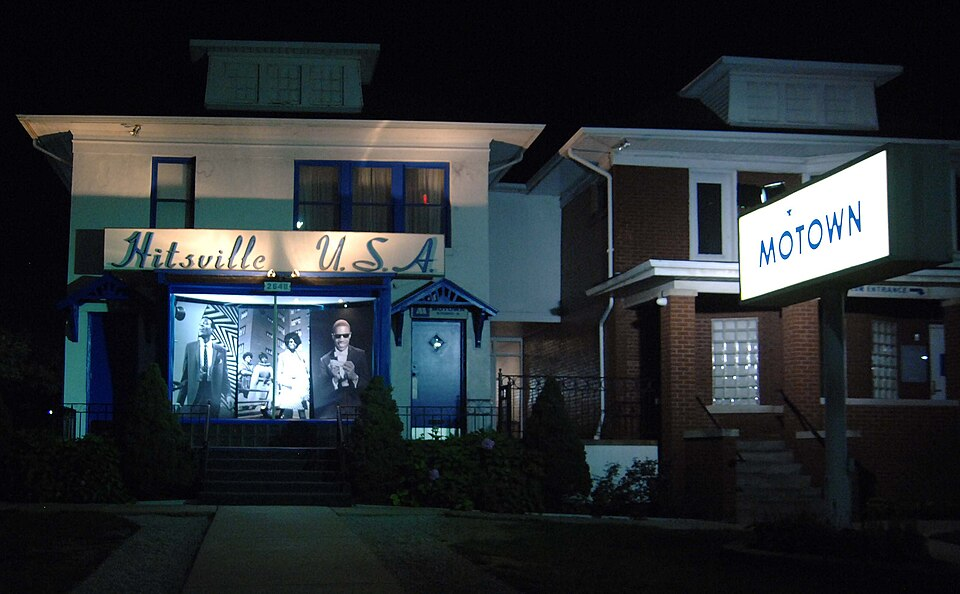
The Motown Museum
Source: Moundcreek (Wikimedia Commons)