
In the wake of Motown’s success, a number of entrepreneurs set up small record labels in Detroit. There are some hidden gems amongst their output.
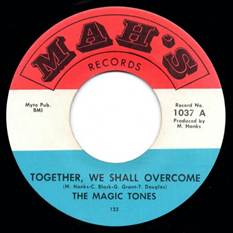
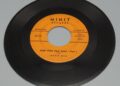
MAH’s Records was a Soul label founded in 1960 by Johnnie Mae Matthews and Mike Hanks, who was born in 1929 in Bessemer, Alabama. He came to Detroit to find a job and got into the music industry. Hanks started out as a singer/songwriter, making his first recording in Detroit in 1958/9. Four years on, he was arranger and director (and co-writer with Buddy Lamp) of the powerful Blues-tinged 1962 single “Tears Baby”/ “It Ain’t Love” on Carmen Murphy’s Soul label, sung by Johnny West. Hanks’ last recording came in 1963, but by then his priority was clearly to run his labels and write/arrange/produce songs for his roster of artists.
The name MAH’s is derived from his initials, Michael Alonzo Hanks. He soon became sole owner of the label when the deal with Matthews came to an end. The label issued twelve singles between 1960 and 1963. The second of these features Billy Kent singing with the Andantes, but the song that Hanks and Matthews had written for them was not strong. The fourth is much better, with Mike Hanks taking the lead vocal and the Del-Phis providing the backing. The Del-Phis were soon to turn into Martha & the Vandellas! In 1968, a couple of singles were released on the MAH’s label by The Magic Tones.
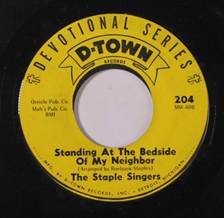
D-Town Records was established by Hanks in 1963, with the release of the first single during the same year and the last in 1966. Rudy Robinson led the session band (on keyboards) and also wrote songs and did many of the arrangements for the label. Most of the output was aimed at the Pop market.
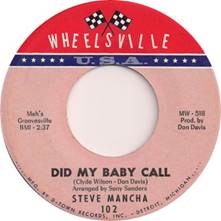
Wheelsville USA was set up in 1965, to overlap with D-Town. Around twenty-three singles were issued over the next two years. Several of the artists switched to Wheelsville USA from D-Town, with the emphasis still on the Pop market. The best of the Wheelsville releases is Buddy Lamp’s “Save Your Love”/ “I Wanna Go Home” from August 1967. The B-side was co-written by Lamp, McKinley Jackson and William Garrett and is a good example of Detroit Soul. The A-side is from the pen of Don Bryant, a pure Memphis Soul classic.
Will Hatcher set up a Wheelsville Records in the late seventies. It is unrelated to Mike Hanks’ company.
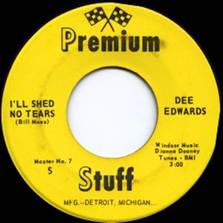
Premium Stuff was the last of Mike Hanks record companies. Some of the artists were signed to his earlier labels and some of their singles were re-released on the new label. Jack Ashford and Bobby Croft provided an excellent song for Lee Rogers in 1969. “I Need Your Love (To Satisfy My Soul)” has real Northern Soul appeal.
Mike Hanks’ ten-year contribution to Detroit Soul and R&B came to an untimely end in 1970. He was shot outside the 20 Grand Ballroom.
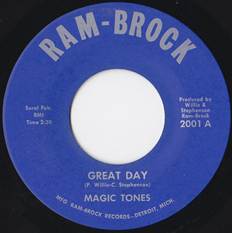
Ram-Brock Records was led by D-Town’s musical director Rudy Robinson, who had decided to go his own way. He set up his new label with financial support from a group of local doctors in a recording studio in Detroit that had previously belonged to Viney Records. Four singles were released on the label, two in 1967, soon after the Detroit riots, and two in 1968.
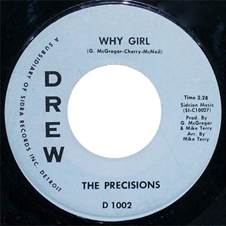
Drew Records was established in 1966 as a subsidiary of John Pavlik’s Sidra Records (Pavlik was also known as Johnny Powell). It was set up to issue the recordings of just one act, the Precisions.
The Precisions began recording in 1960, as a Doo-Wop quartet, with releases on a number of small labels. In 1964, they switched to D-Town Records to record a couple of their own compositions which were arranged and produced by Mike Hanks. Then in 1966, they moved again to Drew. The founder members of the group were Arthur Ashford, Michael Morgan, William Prince and Dennis Gilmore. Robert Lowe was then added. The label released two singles in 1966, one as a promo that didn’t go on general release. Then, in 1967, the group broke into the Billboard R&B Singles Chart (number twenty-eight) with “Why Girl”, a song co-written by Mike Terry, George McGregor and Doris McNeil, arranged by Terry and produced by Terry and McGregor. (All three had connections with Motown).
The same co-writing trio also provided the B-side for the group’s next single, “If This Is Love (I’d Rather Be Lonely)” / “You’ll Soon Be Gone”, released in August 1967. Their contribution is outshone by the A-side, an up-tempo ballad with strings and horns that would have suited the Four Tops. The Precisions deliver the dramatic vocals with verve, and it soon became their most successful song, reaching number twenty-six on the Billboard R&B Singles Chart and number sixty on the Billboard Hot 100 Singles Chart. It was written and produced by Cholly Bassoline, Marty Coleman and Michael Valvano with arrangements by Mike Terry. (It also sounds as though Terry is playing on the recording!).
The follow-up in 1968 was their last chart entry (Billboard R&B Singles Chart at number fifty). The single “A Place”/ “Never Let Her Go” features two songs from Bobby Eaton, Fred Bridges and Richard Knight, who also produced the single, with arrangements by Mike Terry. Eaton and Bridges were members of the Brothers of Soul group. Richard Knight (real name Richard Dunbar) sang with the Knight Brothers.
Drew closed down soon after, and the group moved to Atco Records.
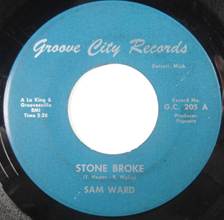
Groove City Records was set up in 1967 by Don Juan Mancha, who developed an interest in the music industry at an early age. In High School he joined the Delrays, whose lead vocalist was Barrett Strong and started writing songs. After a stint in the army, he signed for LuPine Records, where he played piano. One his songs was developed into “I Found A Love”, recorded in 1962 by the Falcons with Wilson Pickett. He later moved to Wilbur Golden’s Correc-Tone Records and then to Golden World. When that was bought out by Berry Gordy, Mancha took the opportunity to go his own way.
The label was in operation for two years, releasing seven singles. They are all worth listening too, with five of them real collectors’ favourites. Robert Ward and Fred Briggs led the way in 1967 with two singles both produced for Washday Productions, which only commissioned one other single, a 1967 Carla Thomas song “Pick Up The Pieces” that was produced by Don Davis and Al Bell. Maybe there was a Memphis link for all three recordings.
Robert Ward was born into a poor family in Georgia. He grew up listening to Blues guitarists and took up that instrument whilst still young. He joined his first group in 1959 and moved to Dayton, Ohio, in 1960 to form the Ohio Untouchables. Robert West brought them to his LuPine label in 1962, where they played on the recording of the Falcons’ “I Found A Love”. The band went on to record at Thelma Records. Ward left the Ohio Untouchables in 1965 and turned up in the early seventies at Motown, where he played as a session guitarist. In the intervening seven years, there is not much evidence of his work – just one single, recorded at Groove City, but what a single. The A-side “My Love Is Strictly Reserved For You” was written by Clyde Wilson, a.k.a. Steve Mancha. It is a slow, Blues-inspired Soul ballad, with a simple arrangement that lets Ward’s expressive voice do the work. The B-side “I Will Fear No Evil”, co-written by Anthony Hawkins and Roosevelt Veasey, is more up-tempo with a stronger backing and just as powerful.
Fred Briggs was essentially a songwriter/producer, but he cut two singles in the sixties, one in 1964 for Congress Records (“The Train Song”) and one in 1967 for Groove City. The first is a good song written by Johnnie Northern with a Doo-Wop arrangement. The second is also a Northern/Briggs composition, but it is a slow Soul ballad that shows Briggs in a totally different light. The B-side, “I’m So Sorry”, is just as strong, written by Briggs, who also co-produced the single along with Don Davis, with a definite touch of Memphis on both tracks.
Steve Mancha leads the way into the 1968 tracks, with an excellent song that he co-wrote with Don Davis entitled “Hate Yourself In The Morning”. Is it an odd coincidence to see Steve Mancha recording at Groove City Records for Don Juan Mancha? The name Mancha surely wasn’t very common in Detroit. The explanation goes back to 1965, when Clyde Wilson (Steve Mancha’s real name) moved to Wheelsville Records. Owners Don Davis and LeBaron Taylor wanted Wilson to change his name but couldn’t think of a good alternative. When the suggestion Mancha was put forward, everyone agreed it would stand out, so they asked Don Juan Mancha if he minded lending his family name to Wilson. When he agreed, Clyde Wilson became Steve Mancha, although he retained his original name for his songwriting credits.
His sole release on the Groove City imprint is a good Soul ballad with an interesting arrangement. Mancha’s vocal is spot on.
Sam Ward was next in line with “Stone Broke”. Sam Ward had been at Motown from 1960, but his Blues style didn’t suit the Motown sound. Singin’ Sammy Ward, as he was known at Motown, left that company in the mid-sixties. Four years later he came to Groove City to record one single, still singing the Blues. “Stone Broke” is another excellent song, co-written by Richard “Popcorn” Wylie (studio musician and Head of A&R at Motown in the early years) and Tony Hester (member of the Holidays), and produced by Wylie. Ward retired from the music business after the single failed to sell, with one other single appearing in 1977 on the Detroit label Renaissance 76. Much later, in 1989, the UK record producer Ian Levine persuaded Ward to record a series of tracks for Levine’s Motorcity label and to come to the UK to perform in the Northern Soul clubs. Ward died in Mount Clemens, Michigan, in 1996.
The last of the highlighted singles is “Easy Living”/ “I Lost You” by Hollidays. The A-side is another composition from Jack Ashford and Bobby Croft, which Ashford also produced. The B-side is a song written and produced by Tony Hester, a member of the band. Hollidays is a difficult band to pin down, with various spellings of the group’s name and frequent changes of personnel, but it appears that the lead vocal on “Easy Living” is the work of Steve Mancha. No wonder this track is much better than anything the Holidays recorded at Revilot in the mid-sixties. The single may be a bit of a hybrid, however, as the B-side is a song written and produced by Tony Hester, who was a member of the Holidays.
Carla, Karen, Moira and Ruth Records were all owned by Ollie McLaughlin. Three of the four labels were named after his daughters, with Ruth the odd one out. She was his wife!
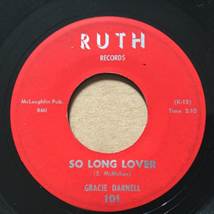
Ruth Records was his first venture into the record industry, which he founded in 1959, issuing just two singles which are Doo-Wop in style and aimed at the Pop market.
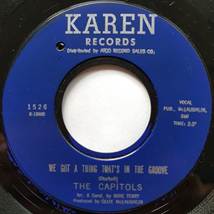
Karen Records came next, in 1961. McLaughlin’s second label was much more successful, issuing around sixty singles between 1961 and 1969, with some well-known names on the roster. Barbara Lewis kicked things of with A Doo-Wop Pop song, “My Heart Went Do-Dat-Da”. Things continued in this vein for about four years. Then, Karen put a song into the charts. In 1966, the Capitols recorded the Donald Storball song “Cool Jerk”, arranged and conducted by Mike Terry and produced by McLaughlin. The magic ingredient was a group of session musicians who were moonlighting from Motown. They added a Jazzy swing to the song and it took off, reaching number seven on the Billboard Hot 100 Singles Chart and number two on the Billboard R&B Singles Chart.
McLaughlin soon made sure that the label kept up a flow of R&B songs. The Soul Twins (Hal and Harold Degraffenreid) were discovered by songwriter Johnny Griffith, who brought them to Karen to record another Northern Soul classic, “Quick Change Artist”, which Griffith had written with Richard Greene. The follow-up was “Just One Look”, which Doris Troy had taken into the charts in 1963. The song was covered by the Hollies in the UK in 1964.
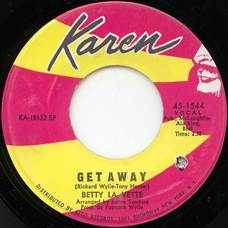
Betty Lavette came to the label in 1968. Karen released four Lavette singles, two in 1968 and two in 1969, before she moved on to Silver Fox. The best of the singles is a powerful version of “Let Me Down Easy”, co-written by James McDougal and Wreich Holloway (Dee Dee Ford’s married name), which had first appeared in 1965 on New York’s Calla Label. The 1969 single has a very good new arrangement by Dale Warren.
Carla Records was the next McLaughlin label to be set up, in 1964. Around forty singles were issued, the majority between 1964 and 1969. Most of them are essentially easy-listening ballads, but two acts stand out.
Jimmy Delphs’ two singles both have a good Northern Soul feel, with “I’ve Been Fooled Before”/ “Almost”, issued in 1967, and “Dancing A Hole In The World” following in 1969, written by Tony Hester, arranged by Mike Terry and produced by Ollie McLaughlin.
The Gambrells were a Detroit female vocal trio, Sharon Gambrell, her sister Sandra Gambrell, and a close friend Patricia Hunt, who was fourteen years old when she joined the sisters. Hunt was also the group’s songwriter! When Ollie McLaughlin heard them in 1964, he quickly recorded their first single “Pain in My Heart”, which Hunt had written in the style of the Marvelettes. The girls also sang as backing singers on several Carla singles. The group’s second release came in 1966. “You Better Move” is much better and certainly showed the girls’ potential. However, they moved on to Pioneer Records in 1966 and later went to Cub Records, with two later songs reverting to their initial style.
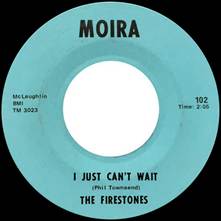
Moira Records was the last of McLaughlin’s four labels, established in 1968 and active for just a couple of years, with nine singles being issued in that time. The artists roster was short with just four acts. All the singles are dance tracks, with several instrumentals, and all are on the funky side of R&B.
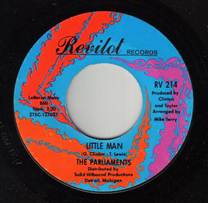
Revilot Records survived the 1967 riots, but closed after two more years. During this time, the label released singles by J.J. Barnes, Parliaments, Terry Felton, Holidays and Little Sonny.
J.J. Barnes came to Revilot in 1968, having recorded two singles at Groovesville in 1967. Revilot beat that, putting out three singles in the first year. “Now She’s Gone” and “Sad Day A-Coming” are both mid-tempo ballads written and produced by Barnes, with Richard Parker co-producing. They are good, but the third release, a cover of Darrell Banks’ 1966 hit “Our Love Is In The Pocket”, is probably the best.
The Parliaments did better than J.J. Barnes.Revilot put out four of their singles in 1968. They are all pre-funk era mid-tempo ballads with some good harmonies. Most of the tracks were written or co-written by George Clinton and produced by LeBaron Taylor, with some input from Clinton. The most interesting of the four is “Little Man”, released in January 1968, which has an arrangement by Mike Terry.
Terry Felton cut her one and only single on the Revilot label in 1968. “I Don’t Want To Have To Wait” was written by Don Culver and produced by Charles Chalmers, who had worked in Muscle Shoals, Memphis and Chicago. Felton’s track is a cover of Barbara & the Brown’s original from 1966 on the Cadet label, (also produced by Chalmers!), which was covered by James and Bobby Purify for Bell Records in 1967. The B-side “You’re Welcome Back” was written by Larry Chambers and Raymond Moore, who were associated with Malaco Records in Jackson, Mississippi, and again produced by Chalmers. It doesn’t look like a Detroit single; it sounds more like a single from Memphis or Chicago. It’s worth a listen, nevertheless.
Little Sonny cut his third and final Revilot single in 1969, two up-tempo tracks in his Bluesy style.
Holidays also saw a third and final single released in 1969. Soon after that, the label was declared bankrupt and shut down.
Some labels based in other cities came to Detroit to record some of their output.
Stax/Volt Records was based in Memphis. The company hired Detroit-based producer Don Davis around 1968, who quickly had great success working with Johnny Taylor. In 1971, Davis bought United Sound Studios in Detroit and developed a successful songwriting and recording business in his home city through his companies Groovesville Productions and Groovesville Publishing. Isaac Hayes, Aretha Franklin and George Clinton were the best-known R&B performers to record at United Sound during this period.
The Dramatics were a Detroit group founded in 1964 as the Sensations. Members were Ron Banks, Larry Demps, Roderick Davis, Elbert Wilkins and Larry Reed. They became the Dramatics in 1965, when they signed for Ed Wingate’s Wingate label, where they recorded a couple of singles at the Golden World Studio, before moving to Sport Records, another small Detroit label. It was at Sport that they had their first chart success with the single “All Because Of You”, co-written by Sidney Barnes and Andre Williams.
In 1967, two members of the group, Roderick Davis and Larry Reed, plus the group’s valet Fred Temple, were caught up in a major incident at the Algiers Motel in Detroit, when the Detroit Riots erupted on 25th July. When shots were reported in the area, a large group of police officers, State Troopers and National Guard members was sent to the Motel. A gunfight ensued, during which two young Black men and the Dramatics’ valet Fred Temple were killed. Reed and Davis survived the attack but left the group not long after.
In 1968, the group signed for Stax, with new members William Howard and Willie Ford. They cut one single, “Your Love Was Strange”, which was released on the Volt subsidiary in 1969, but it led nowhere. Then, two years later, they had two strokes of luck. They met songwriter Tony Hester, who saw them in a Detroit club and offered them a song, “Whatcha See Is Whatcha Get”, which Hester registered with Groovesville Publishing and no doubt recorded at United Sound. They were then offered a new contract with Volt by Don Davis. They were delighted when the single rose in the charts to number nine on the Billboard Hot 100 Singles Chart and number three on the Billboard R&B Singles Chart.
The single soon gave rise to an album, which contains eight tracks, all written and produced by Tony Hester. The album “Whatcha See Is Whatcha Get” was recorded partly at United Sound, partly at the Artie Fields Studios in Detroit, and partly in Memphis at the Stax Studios. It is a collection of slow ballads, with a few funkier tracks, all arranged by Johnny Allen. The success of the single helped push the album to number twenty on the Billboard 200 Albums Chart and number five on the Billboard R&B Albums Chart.
Two members left at this point to form a group of their own. William Howard was replaced by L.J. Reynolds, and founder-member Elbert Wilkins was replaced by Lenny Mayes. Unfortunately, the two departing members wanted to use the Dramatics name, which led Don Davis to recommend a change of name for the original group to Ron Banks & the Dramatics. After four years of legal wrangling, Howard and Wilkins were forced to stop using the name Dramatics. They came up with a new group title, A Dramatic Experience, which just happened to be the name of the group’s 1973 album! It also charted, but only reached number eighty-six on the Billboard 200 Albums Chart and number eleven on the Billboard R&B Albums Chart. A third album followed in 1974, entitled “Dramatically Yours”, which failed to enter the main Pop chart but did peak at number thirty-six on the Billboard R&B Albums Chart.
Stax Records released seven more singles from the three albums on the Volt label, following the first gold-certified single. All but the last made chart entries, but the most successful by far was “In The Rain”, which climbed to number five on the Billboard Hot 100 Singles Chart and number one on the Billboard R&B Singles Chart, earning the group another gold disc, for sales of over one million copies.
In 1974 the group moved from Stax to Cadet Records in Chicago, where Don Davis was now engaged. They later signed for ABC, continuing to build a successful career, the highlight of which was the album “Do What You Wanna Do” (1978), that was gold-certified by the RIAA in 1978. This album and other singles were recorded in Detroit. The album embodies the smooth and polished sound that was characteristic of late 1970s R&B and soul music. “Do What You Wanna Do” blends elements of Soul, Funk, and Disco, reflecting the musical trends of the time.
The title track, “Do What You Wanna Do,” was a standout single, embodying the album’s overall upbeat and danceable vibe. The song’s infectious rhythm and catchy melody contributed to its popularity on the dance floors during the disco era. The album was produced by Don Davis, who was a significant figure in shaping the sound of The Dramatics. Davis’s production style added a layer of sophistication to the group’s music, incorporating lush arrangements and polished instrumentation.
ABC Records was also home to the Floaters, another Detroit group that recorded in the city from the mid-seventies. They are best known for their hit single “Float On”, which became a major success in 1977. The Floaters were formed in 1976 in Detroit, originally as a spin-off from the R&B group The Detroit Emeralds. James Mitchell was the primary creative force behind the group, contributing to songwriting and production.
In 1977, The Floaters released their self-titled debut album, which included the single “Float On”. This track became their signature hit and was a standout for its unique structure and mellow, dreamy vibe. Each member of the group introduces themselves by name, zodiac sign, and a brief spoken verse, followed by a smooth, harmonized chorus. “Float On” resonated with listeners and became a massive hit, reaching number two on the Billboard Hot 100 Singles Chart and number one on the Billboard Soul and R&B Singles Chart in the United States, where it became a gold-certified single according to the RIAA. It also performed well internationally, particularly in the UK, where it reached number one on the Official UK Pop Singles Chart, receiving a silver disc from the BPI on 1st August 1977. The parent album “The Floaters” went on to achieve both gold and platinum certifications in America.
Cadet Records had given Don Davis a chance to work with the Dells for a short time in 1973, while they were contracted to the Chess Records subsidiary. They came to Detroit to record an album at United Sound Studios, with Davis as producer. The single “Give Your Baby a Standing Ovation”, taken from the parent album with the same name, was awarded gold certification on 30th July 1973.
Columbia Records set up a similar arrangement with Don Davis for Johnnie Taylor (after many years at Stax) to record the album “Eargasm” in Detroit, with Davis producing. It became a major hit, receiving gold certification on 5th April 1976 and platinum certification on 7th November 2001. A single was also released from the album, which made history. The RIAA had just revamped their accreditation system in 1976, introducing a platinum award for single sales over two million copies, when Taylor’s single “Disco Lady” was issued. It was the first single to gain the award!
There were many more small labels operating in Detroit during the ten years following the Detroit Riots. Most of them released very few singles (some only one!) and many didn’t stay in business for very long. The labels referred to above represent those that had some personnel links to Motown or those that contributed most significantly to the Signature Sound of Detroit.