
At the start of the seventies, under the creative direction of Norman Whitfield, the Temptations continued to produce a hard-edged sound, very different from their music production run with Smokey Robinson. In the process the Temptations ended the 1960s and began 1970s at the top of the Billboard R&B Albums Chart with the studio album “Puzzle People”. Their next studio album, “Psychedelic Shack”, which was released on 6th March 1970, also achieved the number one position on the Billboard R&B Albums Chart week-ending 18th April 1970 (4 weeks). It was later gold-certified on 12th October 1999. The title track was also gold-certified on that date, nearly thirty years after its release on 28th December 1969.
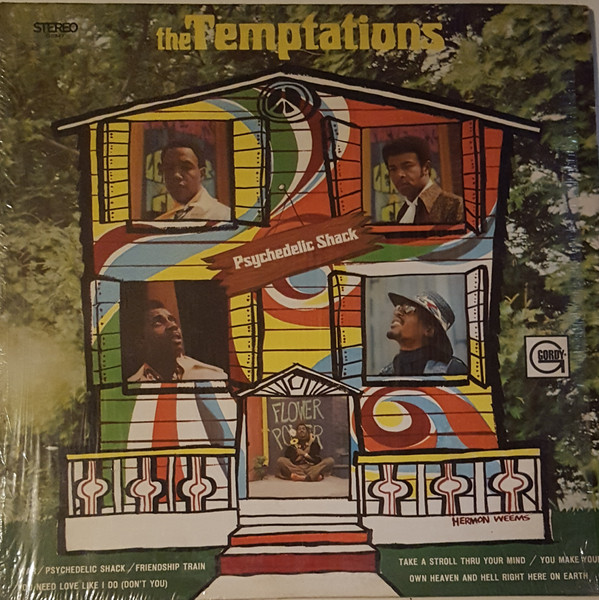
The song “Psychedelic Shack” was sound-engineered and mixed with special sound effects, which certainly attracted attention. The song begins with the sound of a knock on a door that then creaks open, followed by loud voices. The listener is welcomed to the party by the beats of a bass drum and Dennis Coffey’s funky, aggressive, wah-wah hard rock intro. The bass guitar, a hi-hat cymbal, other percussion instruments and drum beats (Uriel Jones?) drive the song along. The vocal arrangement is a complex combination of Soul, Funk and Psychedelic Rock, which was now Norman Whitfield’s trademark.
The follow-up single, “Ball of Confusion (That’s What the World Is Today)” was co-written by Barrett Strong and Norman Whitfield. It was released by Gordy Records on 7th May and proved extremely popular, reaching number two on the Billboard R&B Singles Chart, week-ending 20th June, and number three on the Billboard Hot 100 Singles Chart, week-ending 27th June. It also went to number one on both the Cash Box Top 100 Singles Chart week-ending 25th July (1 week), and the Cash Box R&B Singles Chart week-ending 11th July (3 weeks).
The original backing track from the Funk Brothers lasted almost eleven minutes! It was used by the Undisputed Truth for their 1971 version of the song, but it was reduced to four minutes for the Temptations. Bass player Bob Babbitt described the studio session in an article in Mojo Magazine in 2009: “There was no song, just some musical ideas, some chord patterns, and part of a bass line he (Whitfield) played us. Norman knew what he wanted though, that it was going to be funky. He’d been listening to a lot of Hendrix, Sly & the Family Stone, that’s the sound he wanted to make the Motown sound.” (Reported by Hal Horowitz on the American Songwriter website.)
The final mix from the sessions included heavily reverberated percussion instruments driven by powerful beats from Jack Ashford (percussion) and Uriel Jones (drums), plus grungy, echo-laden wah-wah guitar expressions from Dennis Coffey, with additional guitar support from Eddie Willis, Joe Messina and Wah Wah Watson. The vocals were then added, featuring the aggressive, expressive voice of lead vocalist Dennis Edwards’ singing in the style of a preacher:
“Segregation, determination, demonstration, integration, aggravation, humiliation.
Obligation to our nation… Fear in the air, tension everywhere
Population out of hand, suicide, too many bills.
So, round and around and around we go.
Where the world’s headed, nobody knows”.
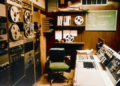
The intricate vocal arrangement by Barrett Strong weaves each singer’s individual vocal range into a series of complex harmonies, which are supported by powerful staccato horns. The Funk Brothers were masters of improvisation, adding extraordinary bass lines and guitar rhythms using wah-wah pedals and other techniques such as reverb, echo phasing and distortion to create the “psychedelic” feel. The song stands out for its vocal complexity, using layered four part harmonies and also for its focus on social issues that were being played out in the community at large, especially after the assassination of civil rights leader Martin Luther King. Like many people at Motown, Norman Whitfield and Barrett Strong were greatly influenced by the Civil Rights movement. They were happy to incorporate social and political themes into their songs. “Ball of Confusion (That’s What the World Is Today)” is also an excellent demonstration of Motown’s ever-improving recording capabilities, with the equipment undergoing continuous development under the supervision of the formidable senior engineers Russ Terrana and Mike McLean. The sound quality of the single is very good indeed.
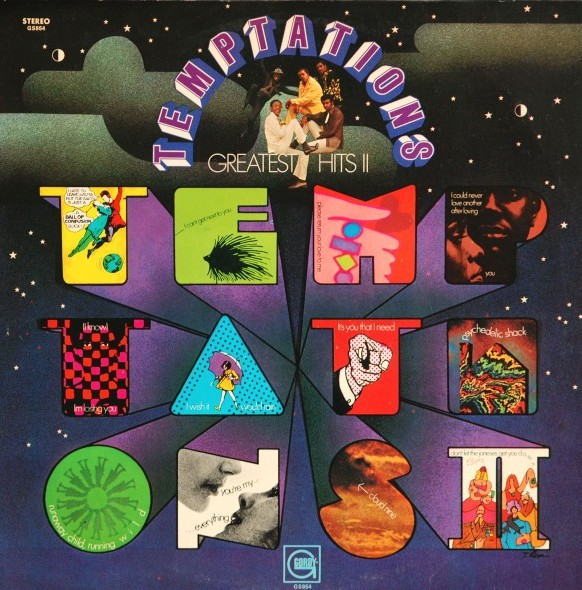
The song was included on the compilation album “Greatest Hits ll”, which was released on 8th September. It peaked at number two on the Billboard R&B Albums Chart, week-ending 24th October, and charted for forty-five weeks. It also reached number fifteen on the Billboard 200 Albums Chart, week-ending 31st October, spending over seventy weeks on this chart! The album received gold certification on 12th October 1999. It is an excellent collection of the group’s Psychedelic Soul songs.
Work soon started on the songs for their next studio album, due for release in 1971. One of the tracks was chosen for single release and issued by Gordy on September 15th. “Ungena Za Ulimwengu (Unite the World)”, another Whitfield/Strong composition, is a Bluesy, dance track, with the Temptations’ usual smooth harmonies and an off-beat musical arrangement that has some African influences. It charted, but not as well as earlier singles, only reaching numbers thirty-three and eight on the Billboard Hot 100 and Billboard R&B Singles Charts.
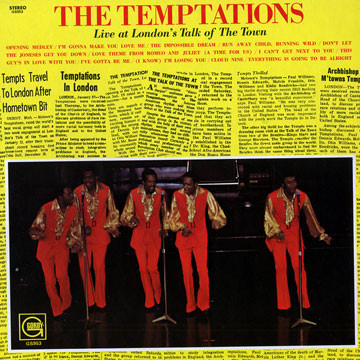
Gordy Records managed to squeeze in another album, “Live at London’s Talk of the Town”, before the obligatory Christmas album. The set list is a collection of many of the Temptations’ hits old and new, plus versions of some other Motown hits and non-Motown classics. The album gives a good impression of the excitement of the Temptations’ concerts and sold well, reaching number twenty-one on the Billboard 200 Albums Chart and number five on the Billboard R&B Albums Chart. The musicians involved were Burt Rhodes and his Orchestra, Cornelius Grant (guitar and musical director), Bill White (bass), Melvin Brown (drums), and Stacey Edwards (congas).
The group’s next studio album was the holiday-themed collection of Christmas favourites, entitled “The Temptations’ Christmas Card”. The album was released on 30th October. The production of the album was shared between Clay McMurray and Barrett Strong, with music by The Funk Brothers and orchestration by the Detroit Symphony Orchestra strings section, as usual. The lead vocals on the album were shared in the main by Eddie Kendricks and Dennis Edwards. It is a mellow set of MOR classics, a long way from the land of psychedelia!
By the end of the year, despite some big chart successes, all was not well with the group. Tensions had been building for some time between Eddie Kendricks and both Otis Williams and Melvin Franklin, and Paul Williams had health problems. Kendricks was not a fan of the new, psychedelic material and wanted David Ruffin to be re-admitted to the group. He also thought that Motown was not dealing fairly with the group’s earnings and suggested strike action. From late 1969, Richard Street had been hired to sing Paul Williams’ parts when required, but the discontent was not settled. Things came to a head in November, when Kendricks walked out between two shows at the Copacabana Theatre. He never returned. His last involvement in the studio had been the recording of vocals for the song “Just My Imagination (Running Away With Me)”, which was released as a single in several European countries in 1970 but only appeared in 1971 in the USA. Kendricks was in touch with David Ruffin, who encouraged him to follow a solo career.