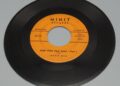

Rare Earth, an all-White R&B/Rock band, were the first signing to Motown’s new Rare Earth label. The group was formed in 1960, as the Sunliners, but didn’t make their first recording until 1968’s “Dream/Answers” on the Verve label, by which time the group’s name had changed to Rare Earth.

The album didn’t made much impression on the market, but it had caught the attention of Motown’s Barney Ales. Berry Gordy duly hired the group in 1969 and took their name for his new label.

Members of the group were Gil Bridges (vocals, saxophone, flute, tambourine), Peter Hoorelbeke (vocals, drums), John Parrish (vocals, bass guitar, trombone), Rod Richards (vocals, guitar), and Kenny James (keyboards). Hoorelbeke was also known as Pete Rivera, and Parrish was also known as John Persh. Towards the end of the year, Eddie Guzman joined the group to play conga drums and other percussion instruments.

The group went into the studio on 3rd July and after two weeks they had completed their first album for Motown, which they called “Get Ready”, after the Temptations’ song. It was released at the label’s official launch on September 30th. “Get Ready” has only six tracks, five on side A and just one on Side B, that is devoted to the band’s cover of Smokey Robinson’s song “Get Ready”. It lasts twenty-one and a half minutes! The A-side is a collection of psychedelic Rock tracks, including “Tobacco Road” and “In Bed”, which betray the influence of bands such as Cream.
It was amazingly successful, reaching number twelve on the Billboard 200 Albums Chart and number four on the Billboard R&B Albums Chart, later earning platinum certification for the group. What a start for the new label. They were then asked to contribute music to a film project. The “Generation” soundtrack was released but soon withdrawn when the film failed at the box-office. Three of the tracks were later included on the band’s 1970 studio album “Ecology”.
With the benefit of having their label named after them, Rare Earth had already made quite an impact. They had started working with arranger/producer Tom Baird for the failed 1969 film score project “Generation”, and he continued in those roles for their “Ecology” album, which was released in June.

The new album contains just seven tracks, three of which were remixed versions of songs from the “Generation” soundtrack. Three of the four extra tracks were written by Tom Baird, and the other was a cover of the Temptations’ “(I Know) I’m Losing You”, co-written by Norman Whitfield, Cornelius Grant and Eddie Holland.
The band were playing Psychedelic Rock with a high level of musical virtuosity, which appealed to the market. The album reached number fifteen on the Billboard 200 Albums Chart and number four on Billboard R&B Albums Chart, even though it had little to do with R&B! It also achieved gold certification from the RIAA on 30th October 2000.
Rare Earth released three singles during 1970, “Get Ready” from their first Motown album, followed by “(I Know) I’m Losing You” and Born To Wander” from “Ecology”, which all made good chart entries. “Get Ready” peaked at number four on the Billboard Hot 100 Singles, earning gold certification in 2000, and also went to number one in Canada. “(I Know) I’m Losing You”, produced by Norman Whitfield, reached number seven on the Billboard Hot 100, and “Born To Wander” peaked at number seventeen on the same chart.
The plan was to reach the young White market, and Rare Earth (the band) certainly did that. It is also likely that young Black fans of Motown were encouraged to listen to their music. Why shouldn’t they like both the R&B and the Psychedelic Rock output from the company?
1971 saw the release of a new studio album, a live album, and three singles. There were also two changes in the line-up. Rod Richards left because he wasn’t happy with the direction in which the band’s music was heading, and Kenny James did not want the pressure of the increasing touring that the band were undertaking. Replacements were swiftly brought in: Ray Monette on guitar for Richards, and Mark Olsen on keyboards for James.

The two new members were in place for the recording of the studio album “One World”, which was released in June. It sold over a million copies, peaking at number twenty-eight on the Billboard 200 Albums Chart and number twelve on the Billboard R&B Albums Chart.
The eight tracks are a collection of melodic Rock songs, some with striking harmonies. The instrumentation includes some excellent guitar work from new member Ray Monette on the opening track “What’d I Say” and also on the closing track “Under God’s Light”, which has an interesting contribution from Gil Bridges on flute. The sound quality is excellent, with the recording conducted by Russ Terrana and Bob Olhsson. Tom Baird produced the album, along with members of the band.
“I Just Want To Celebrate”, co-written by Motown songwriters Dino Fekaris and Nick Zesses, was chosen for single release, backed by band member Pete Rivera’s song “The Seed”. It also charted well, reaching number seven on the Billboard Hot 100 Singles Chart and number thirty on the Billboard R&B Singles Chart.
A second single was the released, linking “Hey Big Brother” and “Under God’s Light”. It charted, but less well, only reaching number nineteen on the Billboard Hot 100 Singles Chart and number forty on the Billboard R&B Singles Chart.

The live album followed later in the year, entitled “Rare Earth in Concert”. It eventually obtained a gold disc from the RIAA on 30th October 2000. It was issued as a double LP, offering three tracks on the first side, just one on the second (a twenty-three and a half minute-long version of “Get Ready”), two on the third (including a cover of Ray Charles’ “What’d I Say”), and two on the fourth. Seven of the eight tracks were recorded live in concert, spread across four different venues. A team of ten engineers ensured the high quality of the sound, with the final mastering done by Russ Terrana. The final track was recorded “live” in Studio A. Of the seven non-covers, two were co-written by Fekaris and Zesses, two by group members, one by Tom Baird, one by Smokey Robinson, and one by Norman Whitfield, Eddie Holland and Cornelius Grant.
Two of the tracks formed the last of the band’s 1971 singles, “What’d I Say” backed by “Nice To Be With You”, which reached number sixty-one on the Billboard Hot 100 Singles Chart in 1972.
That was the last of their Detroit releases. The group spent the following year working on their next album, due for release in October 1972. By then, Motown had moved to Los Angeles.