
Stevie Wonder’s fourteenth studio album “Music of My Mind” was released on 3rd March 1972 on the Tamla label. It became the first recording project under his new contract with the Motown Corporation, which gave him full artistic creative freedom. Taking advantage of this new development, Wonder decided to enlist the services of electronic music pioneers and innovators Robert Margouleff and Malcolm Cecil. Both men collaborated on the album as associate producers and sound engineers, taking care of programming on both the Moog and Arp synthesizers. They also used their custom T.O.N.T.O synthesizer on several tracks to great effect, creating some very interesting results. The album was recorded between Los Angeles on the West Coast (Crystal Industries) and New York on the East Coast (Mediasound Recording Studio, the former Manhattan Baptist Church building, and the Electric Lady Studios in Greenwich Village, founded by Jimi Hendrix).
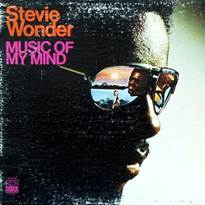
This was a brave decision, a complete departure by Wonder from the usual Motown signature sound that had dominated his recording career for the previous ten years. He was moving into untried musical territory in search of a more contemporary Progressive Soul sound, which would mix Smooth Soul with Funk. This album was the beginning of a golden era of explosive musical innovation and exploration. He was a one-man band, playing instruments including piano, drums, T.O.N.T.O synthesizer, Rhodes piano, talk box, bongos, clavinet, harmonica, and Moog bass. There were, nevertheless, some additional musicians on the project, notably Buzzy Feiten on electric guitar, who is featured on “Superwoman”, and Art Baron on trombone, who played on “Love Having You Around”, co-written by Wonder and his then wife Syreeta Wright, who sings background vocals on “Sweet Little Girl”. Emphasising the new Stevie Wonder regime are two key points: he produced the whole album, and he wrote all the songs, one with Syreeta mentioned above and two with Yvonne Wright, “Evil” and “Girl Blue”.
The majority of the album’s nine tracks are mid-tempo love ballads, driven along by Wonder’s bass, drums and rhythmic keyboards. The melodies are simple but with regular unexpected changes and Wonder’s vocals are controlled and precise, with some clever harmonies. The final track “Evil” is the best example of this new approach, with the strongest vocals and greater clarity than some of the other tracks.
All the songs are built in the same way, which may have left some listeners wanting more variety. Nevertheless, the album sold well, charting to number twenty-one on the Billboard 200 Albums Chart week-ending 15th July and staying on that chart listing for thirty-five weeks. The reception in the R&B market was very good, with the album reaching number six week-ending 8th July on the Billboard R&B Albums Chart listing. The album sold just over a quarter of a million copies in America. It was the beginning of great things to come for Stevie Wonder, after the many years learning from the best at Motown in the Snake Pit of Studio A. Now he was ready to take control of his career, starting with his own publishing company Black Bull Music, which he had set up in 1971 and affiliated with ASCAP (The American Society of Composers, Authors, and Publishers), thus breaking the link with Motown’s Jobete Publishing.
The late Penny Valentine, music journalist and pop music critic for the Sounds UK weekly pop/rock music newspaper, was highly enthusiastic about the album, which she described as “a milestone in contemporary music”. She was particularly impressed by Wonder’s “intriguing vocal patterns” on what she deemed “an album of explosive genius and unshackled self-expression”. (Sounds, 4th December 1972).
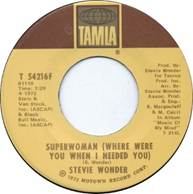
The first single to be drawn from the album was “Superwoman (Where Were You When I Needed You)”, with a recording length of eight minutes and six seconds on the album but reduced to three minutes twenty-nine seconds for the single. It was issued on 25th April. Wonder played almost all of the instruments on the track, with just the electric guitar played by Buzzy Feiten added to the mix. Feiten was a highly-trained musician who added outstanding guitar riffs in syncopation with Stevie Wonder’s vocals. Wonder sings both lead and background vocals in harmony, just as Marvin Gaye had done on his “What’s Going On” album, demonstrating his ability to sing with tender, soft and smooth vocal expression on this delicate ballad. The single charted to number thirty-three on the Billboard Hot 100 Singles Chart and number thirteen on the Billboard R&B Singles Chart.
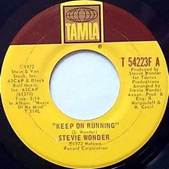
The second single from the album was “Keep on Running”, issued by Tamla on 15th August. It was less successful than the first, charting to number ninety on the Billboard Hot 100 Singles Chart and number thirty six on the Billboard Soul and R&B Singles Chart.
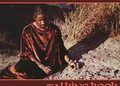
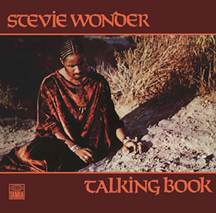
“Talking Book”, released on 27th October 1972, was Stevie Wonder’s fifteenth album, produced entirely under his artistic control. In musical terms, it embodies a richly eclectic blend of Soul, Funk, R&B and Pop, fused with elements of Rock and Jazz harmony. What makes it distinctive is the way Wonder combines socially conscious lyrics and personal storytelling with new soundscapes made possible by synthesisers, particularly the TONTO (The Original New Timbral Orchestra) modular system.
Source: Wikimedia Commons
Recording sessions took place on both the East and West coasts of the United States, at Electric Lady Studios in New York City, Crystal Sound Studios in Hollywood, Los Angeles, and Record Plant Studios in Los Angeles, as well as at Air Studios in London. Electric Lady, built by Jimi Hendrix, provided an environment conducive to experimentation and the layering of electronic textures. Crystal Sound, by contrast, was part of Motown’s Los Angeles base following its move from Detroit. It offered Wonder both professional resources and technical expertise to capture his increasingly self-sufficient, multi-instrumental approach. By moving between these different studios, Wonder was able to fuse the exploratory spirit of New York with the polished craftsmanship of Los Angeles, while also drawing on the precision and engineering talent available in London.
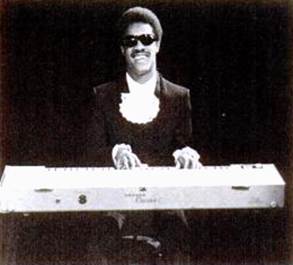
Stevie Wonder 1972
Source: Billboard Trade Ad (Wikimedia Commons)
“Talking Book” peaked at number three on the Billboard 200 Albums Chart in February 1973 and spent three weeks at number one on the Billboard R&B Albums Chart, from 20th January to 3rd February.
One of the most celebrated external contributors to “Talking Book” was the British guitarist Jeff Beck, whose improvisations inspired the early development of “Superstition”. He also appears on “Lookin’ for Another Pure Love”, where his fluid, Blues-inflected guitar lines add a contrasting colour to Wonder’s warm keyboard harmonies.
Another important contributor was Ray Parker Jr., then a young guitarist yet to achieve international fame. On “Maybe Your Baby” Parker’s taut and funky rhythm guitar underpins Wonder’s layered keyboards and vocals. Over the course of more than six minutes, his clipped, syncopated stabs ensure the vamp maintains intensity and momentum, reinforcing the track’s mood of suspicion and tension.
The album also benefitted from the skills of David Sanborn, whose alto saxophone on “Tuesday Heartbreak” cuts through the lush keyboards with sharp urgency, and Buzz Feiten, whose crisp guitar brings rhythmic clarity to the same track. These guest musicians never overwhelm the record but instead highlight Wonder’s ability to frame other instrumental voices within his vision.

The TONTO Synthesizer system
Source: Waeynn (Wikimedia Commons) 2024
Behind the desk, the work of Malcolm Cecil and Robert Margouleff was crucial. Credited as associate producers, they were central to the integration of the TONTO synthesiser system into Wonder’s music. Their expertise allowed him to explore new timbres, transforming the synthesiser from a curiosity into a core element of Funk and Soul. Motown engineers such as Art Stewart, based at Crystal Sound, ensured the final mixes retained warmth and immediacy, balancing futuristic sounds with the organic quality of Wonder’s vocals and live instruments.
The album’s songwriting is largely Wonder’s own, but two of his trusted collaborators also contributed. Syreeta Wright, his former wife and a recording artist in her own right, co-wrote “Lookin’ for Another Pure Love”, her lyrical sensitivity giving the song an added tenderness. Yvonne Wright, another key partner at the time, co-wrote “You and I (We Can Conquer the World)”, a ballad of striking intimacy. Her lyrical input helped bring clarity and universality to the song’s romantic theme, contrasting with the harder-edged funk of “Superstition” and “Maybe Your Baby”. Both writers illustrate how Wonder, even in this phase of independence, still drew on trusted collaborators to enrich his vision.
The sequencing of “Talking Book” demonstrates its range. It begins with “You Are the Sunshine of My Life”, a graceful ballad that earned Wonder his first Grammy Award for Best Male Pop Vocal Performance. The mood then shifts with “Superstition”, built around one of the most celebrated clavinet riffs in popular music and destined to become a defining Funk anthem. Elsewhere, “Maybe Your Baby” reveals a darker, groove-centred character, while “Big Brother” delivers biting political commentary framed by inventive harmonic turns and plaintive harmonica.
“Superstition” was released as a single towards the end of the year. It has become emblematic of Wonder’s genius. He played clavinet, drums and Moog bass, as well as singing both lead and backing vocals. The clavinet riff, jagged and syncopated, defines the track, while the drums drive a taut mid-tempo groove and the Moog bass provides a dense, buzzing undercurrent. Wonder’s vocal is urgent and raw, his backing lines punctuating the rhythm with precision. Although Jeff Beck does not appear on the final version, his input during the writing process was influential. The horn stabs from Trevor Lawrence on saxophone and Steve Madaio on trumpet sharpen the arrangement, while Cecil and Margouleff’s engineering ensured that every element found its place in the mix. In January 1973, the song gave Wonder his second Billboard Hot 100 Singles Chart number one, ten years after the first (“Fingertips Pt 2” in 1963), and two Grammy awards at the 16th Grammy Awards.
Taken as a whole, “Talking Book” is far more than a collection of songs: it is a statement of intent that captures Stevie Wonder’s independence, his technical mastery and his imaginative range. A blend of raw funk, tender balladry and pioneering electronic sound, the album remains unmistakably his creation, further enriched by the contributions of Jeff Beck, Ray Parker Jr., David Sanborn, Buzz Feiten, Trevor Lawrence, Steve Madaio, Malcolm Cecil and Robert Margouleff. Together they helped create a record whose influence spread across Funk, Soul, Rock and Pop, and which continues to be celebrated as one of the defining achievements of 1970s music.
“Talking Book” achieved another first, as the original vinyl pressings in the USA were embossed on the front cover and the inner gatefold with messages from Wonder in braille. The cover has Wonder’s name and the album title. Inside the message reads: “Here is my music. It is all I have to tell you how I feel. Know that your love keeps my love strong. – Stevie”.