
Many people know the names Leiber and Stoller and associate the two songwriters with Elvis Presley’s 1956/7 hits “Hound Dog” and “Jailhouse Rock”, which they wrote. Their names are also associated with the Drifters, for whom they wrote and produced “There Goes My Baby”, “Love Potion #9”, and several more hits. Other fans will remember their work with the Coasters, for whom they wrote and produced “Searchin’” and “Poison Ivy” amongst others.
Much less well-known is the work that Leiber and Stoller did in the early fifties in Los Angeles.
The two songwriter/producers were both born into Jewish families on the East side of the USA, Jerome Leiber in Baltimore, Maryland, in April 1933, and Michael Stoller in New York in March 1933. Their birthdays were just eighteen days apart. Both were educated in Los Angeles, where they met in 1950, aged seventeen. Leiber had started to write songs with a friend from school, who didn’t wish to continue but suggested Leiber should contact a pianist he knew, Mike Stoller. Leiber contacted Stoller but found him very unwilling to become a songwriter. Fortunately for both of them, Leiber didn’t give up that easily. He took some examples of his draft songs to show Stoller, who recognised the Blues structure of these lyrics. They both loved Blues and R&B!
That sealed the partnership and before the end of 1950, they had their first break. Leiber had worked in a record shop while completing his studies, where he had met Lester Sill, the national sales manager for Modern Records. Sills heard some of their songs and offered to introduce the two young men to a few of the local independent record companies, including Modern.
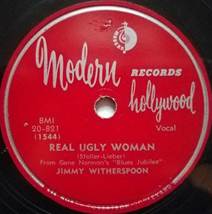
A visit to Modern gave Leiber and Stoller the opportunity to play some of their work to the Robins (who later became the Coasters), who were looking for new songs. The group liked “That’s What The Good Book Says” and duly recorded it. The single was released in 1951, with the songwriting credit given to Stoller-Leiber. Jimmy Witherspoon also picked up one of their songs in 1950, “Real Ugly Woman”, that was also issued in 1951. Neither were hits, but Leiber and Stoller must have been delighted to see their songs on record, associated with two of the West Coast’s well-known names.
Their first hit soon followed, when Charles Brown took “Hard Times” into the Billboard R&B Singles Chart in 1952. Two more songs from 1952 are worthy of note. They were both picked up by popular local singers and must have sold well on the West Coast, but both songs later went on to achieve national success, which made Leiber and Stoller’s names resonate across the music industry.
The first of the two was “K. C. Lovin’”, which, thanks to a contact with producer Ralph Bass, they wrote for Little Willie Littlefield, who recorded it in Los Angeles in 1952 for Federal. The songwriters had written the song as “Kansas City”, largely inspired by the songs of Big Joe Turner, but Ralph Bass changed it. The song was arranged by West Coast musician Maxwell Davis, who plays tenor saxophone on the recording.
The song has never gone away since. It has been recorded by hundreds of artists, including the Beatles, James Brown, and Little Richard. As you read this, it is probably being played in a club somewhere in the world. The most important cover came in 1959, when Wilbert Harrison decided to record it in 1959. With Bobby Robinson producing and Wild Jimmy Spruill on guitar, Fury Records released “Kansas City” in April 1959 and watched it climb to number one on the Billboard R&B Singles Chart. The songwriting credit is now Leiber & Stoller!
The second 1952 sleeper was written for Big Mama Thornton, who recorded it in August 1952 for Peacock Records. The single was issued in February 1953 and topped the Billboard R&B Singles Chart for seven weeks. It has been inducted into the Grammy Hall of Fame (February 2013) and listed as one of the 500 Songs That Shaped Rock and Roll by the Rock and Roll Hall of Fame.
The song has been covered over two hundred and fifty times. The most famous version is, of course, by Elvis Presley, whose 1956 single became his best-selling single, probably reaching ten million units sold. It topped the Billboard Hot 100 Singles Chart for eleven weeks and has also been inducted into the Grammy Hall of Fame (1988).
Following the success of Big Mama Thornton and Little Willie Littlefield with Leiber and Stoller songs, they found it easier to get their work accepted by West Coast artists. Little Esther, one of Johnny Otis’ vocalists, recorded half a dozen of their songs. They also started to think about setting up their own label.
In 1954, the huge successes of “Hound Dog” and “Kansas City” were still in the future, but the two young men, both only 21 years old, teamed up with a few investors to form Spark Record Company. The owners were Leiber, Stoller, Abe Stoller (Mike’s father), Jack Levy, and Lester Sill. It ran for around eighteen months, with a good roster of artists, but Leiber and Stoller then had an offer from Atlantic Records that they could not refuse. Atlantic wanted to buy Sparks and to hire Leiber and Stoller as producer/songwriters. The two men negotiated a deal that gave them the freedom to take on other work with non-Atlantic performers, while still making a major contribution to Atlantic’s R&B and Pop output. They went on to write twenty-four chart entries for the Coasters, plus many more for other well-known artists, becoming two of the first independent songwriter/producers in the industry.
They were inducted into the Songwriters Hall of Fame in 1985 and Rock and Roll Hall of Fame in 1987.
Jerry Leiber died in 2011. Mike Stoller is now (April 2026) ninety-two years old, probably still enjoying listening to their songs!
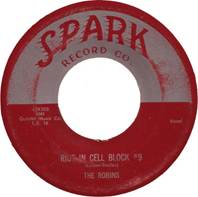
The Spark label started out as a red label with a silver insert carrying the Spark logo. Later the silver section was removed and other colours were used.
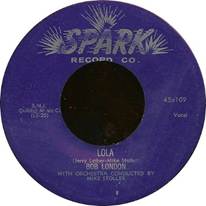
The final design was more striking, a yellow ground with a black insert to carry the logo (see below).
Twenty-two singles were released during 1954/5, with one later addition in 1957. There were fourteen acts on the roster.
Selected Artists on the Spark label
The Robins were the label’s top act. The group’s origin can be traced back to 1945, when Ty Terrell teamed up with brothers Billy and Roy Richard at Alameda High School, in Alameda near Oakland, California, to form the A-Sharp Trio. They finished second in a Johnny Otis talent show in Los Angeles in 1947 and were invited by Otis to sing a regular slot at the Barrelhouse Club. At Otis’ suggestion, Bobby Nunn later joined the trio as the bass/baritone.
In 1949, the group became the 4 Bluebirds, when they made their first recording for Otis Rene at Excelsior in April, before moving to Aladdin in May, to record four tracks for the Mesner brothers as the Robins. Two singles were soon released, one on the Score subsidiary label and the other on Aladdin. They were not big sellers.
Their next move was to Savoy Records, based in Newark, New Jersey, when Savoy talent spotter Ralph Bass recommended to Herman Lubinsky, the owner of Savoy, that he should sign the complete Johnny Otis Revue. Fortunately, all their recordings were made in Los Angeles, including the major hit “Double Crossing Blues”, sung by Little Esther backed by the Robins. The single spent nine weeks at number one on the Billboard R&B Singles Chart.
When the Robins left the Johnny Otis Revue, they moved to John Dolphin’s Recorded In Hollywood label, before making single for Modern. That was where Leiber and Stoller met them. After a stint at RCA Victor and a few more sessions back at Modern, the group signed up with Spark.
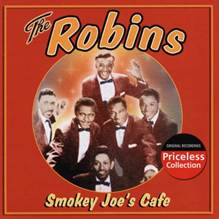
Four tracks were recorded at Master Recorders Studio during the Spring of 1954. The session band featured Mike Stoller on piano, Barney Kessel on guitar, Ralph Hamilton on bass, Gil Bernal on tenor saxophone, and Jesse Sailes on drums. “One Kiss” and “The Hatchet Man” were held back for later release, with the other two tracks paired as the group’s first single. “Riot In Cell Block #9” was the A-side and “Wrap It Up” on the B-side. The dramatic drum beats, the Bluesy sax, and the semi-spoken vocal of the A-side (maybe the voice of Richard Berry rather than Bobby Nunn) make for an unusual song. The subject matter adds another element of surprise, the lyrics aren’t particularly clever, but not many songwriters were choosing to write about a prison riot, nor to make the singer who tells the story a man convicted of armed robbery. Leiber & Stoller’s lyrics were enough to cause CBS to ban the song from their TV and radio stations. The B-side is a Doo-Wop love song! Both were the work of Leiber and Stoller. The Robins undertook a series of concerts across California to promote the new single, including concerts at the Savoy Ballroom and the Hollywood Shrine, plus TV appearances on several local stations.
At the end of summer 1954, they were back in the studio, recording four more Leiber & Stoller tracks. The second single soon followed, a Mambo dance track entitled “Loop De Loop Mambo”, keeping up with the latest fashion. The B-side is “Framed”, a clone of “Riot In Cell Block #9”, with a similar spoken vocal, sax and piano backing. Again, the story is told by a Black man caught up in the criminal justice system, accused of a crime that he says he didn’t commit. Leiber & Stoller were certainly taking song lyrics into dangerous waters, albeit softened somewhat by the strong musical framework. The session band was the same group as played on “Riot In Cell Block #9”.
The next three singles are a mixture of R&B up-tempo dance tracks and Doo-Wop ballads, with Gil Bernal’s saxophone adding some real power. The group’s final release on the Spark label was “Smokey Joe’s Café”, backed by Just Like A Fool”. It was issued just as the sale of Spark to Atlantic was being finalised and was soon to be re-issued on the Atco label.
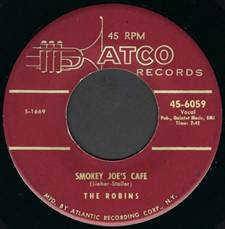
The Atco version, benefitting from the marketing strength of Atlantic, reached number ten on the Billboard R&B Singles Chart and number seventy-nine on the Billboard Hot 100 Singles Chart. Two members of the Robins, Bobby Nunn and Carl Gardner, decided to go to Atlantic with Leiber and Stoller, thus breaking up the Robins. As the Robins’ name had been trademarked by Terrell Leonard, they hired two new singers and formed the Coasters. In January 1956, the new group joined Leiber and Stoller in the studio to start a new phase of their careers.
Willy & Ruth were responsible for two of the Spark singles. The four tracks they recorded are all Leiber & Stoller compositions, including one that was later covered by Elvis Presley. Spark 101, the label’s first issue, combined “Come A Little Bit Closer” and “Farewell”. Spark 105 pairs “Love Me” with “Cordelia”. All four songs demonstrate Leiber & Stoller’s ability to take old-time lyrics and harmonies and wrap them in new R&B clothes. “Love Me” is the best of the set, which is the one chosen by Elvis!
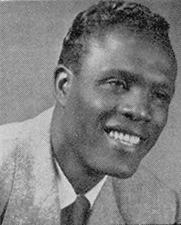
Willy Headen’s background was in Gospel singing. He was lead vocalist for the Kansas City Gospel Singers, who had recorded a couple of singles for Castle Records in 1950 and another for Swing Time in 1951. Following his sessions with Ruth, he switched to singing solo and made recordings on Doo-To, Gardena, and Cyclone Records during the late fifties and early sixties.
Willy also made a further contribution to Spark as the lead singer of the Honey Bears. The group recorded four Leiber & Stoller songs, which were released on two singles in 1954 and 1955. All four have a strong flavour of Gospel, with a dollop of Doo-Wop and an R&B backing.
For lovers of Jazz, Spark session saxophonist Gil Bernal recorded four pieces, two written by him alone and two co-written with Leiber & Stoller.
Several of the Spark releases were recorded elsewhere and leased by Leiber & Stoller. Three tracks came from Clarksdale, issued by Spark under the name of the Sly Fox. Eugene Fox was born in Mississippi in 1928. He was a tenor saxophonist in the Top Hatters band in Clarksdale, where he played with Ike Turner. In 1953, Fox joined the Rhythm Kings. He stayed with Ike Turner’s band for about a year. In the Spring of 1954, Turner recorded three songs with the band in his house in Clarksdale, with Fox taking the lead vocal. Fox assumed it was just a practice session, but Turner then leased the tracks to Spark.
“Hoo-Doo Say”, “I’m Tired Of Beggin’”, and “My Four Women” were released by Leiber and Stoller later that year. To provide the B-side for the second single, a track called “Alley Music” was used. Eugene Fox has a raspy, cigarette-tinged voice that isn’t melodic but suits these Blues-inspired compositions.
Big Boy Groves was born in Oklahoma but came to the West Coast after the war. He recorded at Money, Spark, and Vita, before setting up his own labels, GME and Musette. Two of his tracks were licenced to Spark in 1954. The single “I Gotta New Car”/ “Midnight Special” pairs two of Groves’ own compositions, which proved to be very popular locally. The sax is very much to the fore on both songs, with a strong R&B backing.
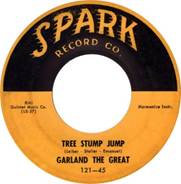
Garland The Great, otherwise known as Emanuel Garland, has one Spark single credited to his not-so-modest stage name. Garland plays harmonica and wrote the two instrumentals on the single with aid of Leiber & Stoller. The A-side “Tree Stump Jump” is a Rock & Roll tune, while the B-side “Hello Miss Simms” is pure R&B.
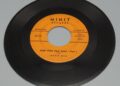
Mister Ruffin was one of the stage names of Nehemiah Ruffin, an R&B and Blues singer and guitarist, who also recorded as Riff Ruffin. He cut his first single at Spark in 1955, combining one of his own songs “Bring It On Back” with one from Leiber & Stoller “A Touch Of Heaven (Just Around The Corner)”. The single was issued twice with A and B sides flipped. The Leiber & Stoller composition is a slow Blues with a good saxophone solo (Gil Bernal?). The Ruffin song is an up-tempo Jump Blues, one of the best of the Spark tracks!
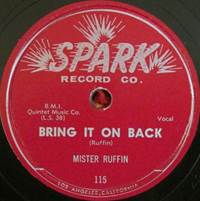
Ruffin went on to record at Cash Records (1956) and Ebb Records (1957), before switching to a series of New York labels in 1958.
Frankie Marshall recorded his first single at Spry in 1954. “Say The Word” from 1955 is a Gospel-tinged foot-tapper, written by Leiber & Stoller, with typical Spark saxophone and piano, presumably courtesy of Gil Bernal and Mike Stoller. Other recordings made with Leiber and Stoller were part of the sale to Atlantic and were released on the Atco label in 1956. Marshall’s last two singles were issued by West Coast labels Jackpot (1958) and Arc (1965).
Ray Agee wasa popular Blues singer on the West Coastduring the fifties and sixties. He made his first recording in 1952 at Modern. His one single for Spark is “Wobble-Loo”/ “Another Fool (Sings The Blues)”. The A-side is an R&B dance track, advertising a dance craze. The B-side is a typical smooth, relaxed Blues from the West Coast, with backing from the Maxwell Davis Orchestra.
Gene & Billy were a duo from Santa Monica. Gene Ford and Billy Boyd were both members of the Chanters, a Doo-Wop vocal quartet, who recorded two singles, one at RPM in 1954 and another at Combo in 1955. When the Chanters disbanded, the two young men teamed up as Gene & Billy, later calling themselves the Cats for their recordings on the Federal label.
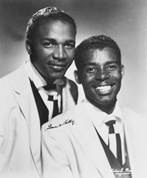
For their 1955 Spark release, they pair two of their own compositions, a Doo-Wop ballad “Zerlene” and a more up-tempo dance track “It’s Hot”.
Robert Byrd And His Birdies made a couple of singles in Los Angeles in 1956 (at John Dolphin’s Cash Records) and 1957 (at Spark). However, the lead singer of the group has many more singles to his name.
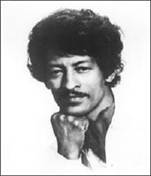
Robert James Byrd has also performed as Bobby Byrd and Bobby Day. He was born in Fort Worth, Texas, in 1928, and moved to Los Angeles at the age of fifteen. In 1948 or 1949, he was a founder member of the Flames, a group formed by a number of high school students in order to perform at a talent show. They were subsequently booked to sing at Johnny Otis’ Barrelhouse Club.
Selective Records gave them their first opportunity to record in 1950, and they went on to have success on the West Coast, recording with Recorded In Hollywood, Spin, Aladdin, Swing Time. 7-11, Lucky, Money, and Ebb, calling themselves the Flames, the Four Flames, the Hollywood Flames, the Jets, the Ebbtides, and the Satellites.
Robert Byrd has also appeared as a member of the Voices, the Sounds, the Crescendos, and in the duo Bob and Earl. Somehow, he also appears on the Spark label with His Birdies. The date given by Discogs is 1957, two years after the label had been acquired by Atlantic; it is hard to understand how that could happen, when other Sparks recordings were issued by Atco.
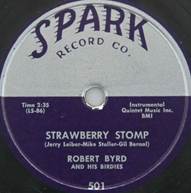
The two tracks on the single are “Bippin’ and Boppin’ Over You” and “Strawberry Stomp”. The A-side is up-tempo Rock & Roll. The mystery deepens when the disc is flipped over. The B-side is an instrumental entitled Strawberry Stomp, for which Leiber, Stoller, and Gil Bernal have the songwriting credit. It is allegedly performed by Robert Byrd and His Birdies, but it is the same track as the one released in 1954 by Gil Bernal as the B-side of his single “King Solomon’s Blues”. Is it really Robert Byrd on Side A? Is it a bootleg release?
As Bobby Day, Robert Byrd built a long career as a performer, producer and songwriter. He had a major hit with Leon René’s “Rockin’ Robin” and wrote several hits for other singers, including “Little Bitty Pretty One” for Thurston Harris and later the Jackson 5.
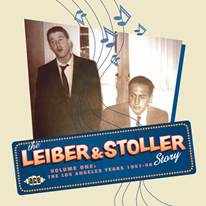
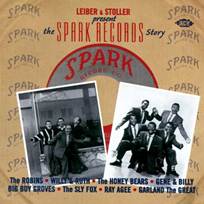
The UK company Ace Records has issued a trilogy CDs that follow Leiber& Stoller’s career. Volume one covers the early years in Los Angeles. It was released in 2004. Three years earlier, Ace had released a thirty-track compilation CD of Spark singles, “Leiber & Stoller Present The Spark Records Story”. It lists the session musicians who played on the recordings:
Jesse Knight jr. and Ralph Hamilton on bass, Jessie Sailes and Bob Prindell on drums, Barney Kessel, Chuck Norris, and Ike Turner on guitar, Mike Stoller and Willard McDaniel on piano, Gil Bernal and Raymond Hill on tenor saxophone. The compilation is an excellent record of their contribution to Spark and to West Coast R&B. It doesn’t include the Richard Byrd and His Birdies track from 1957!